Ventless Hood Guide
Tick the appliances, fuel and menu to get the questions to take to the hood maker and the AHJ, and see the heat that stays in the kitchen.
Recent
Your last 10 settings, saved only in this browser. Nothing is uploaded.
How to use the ventless hood tool
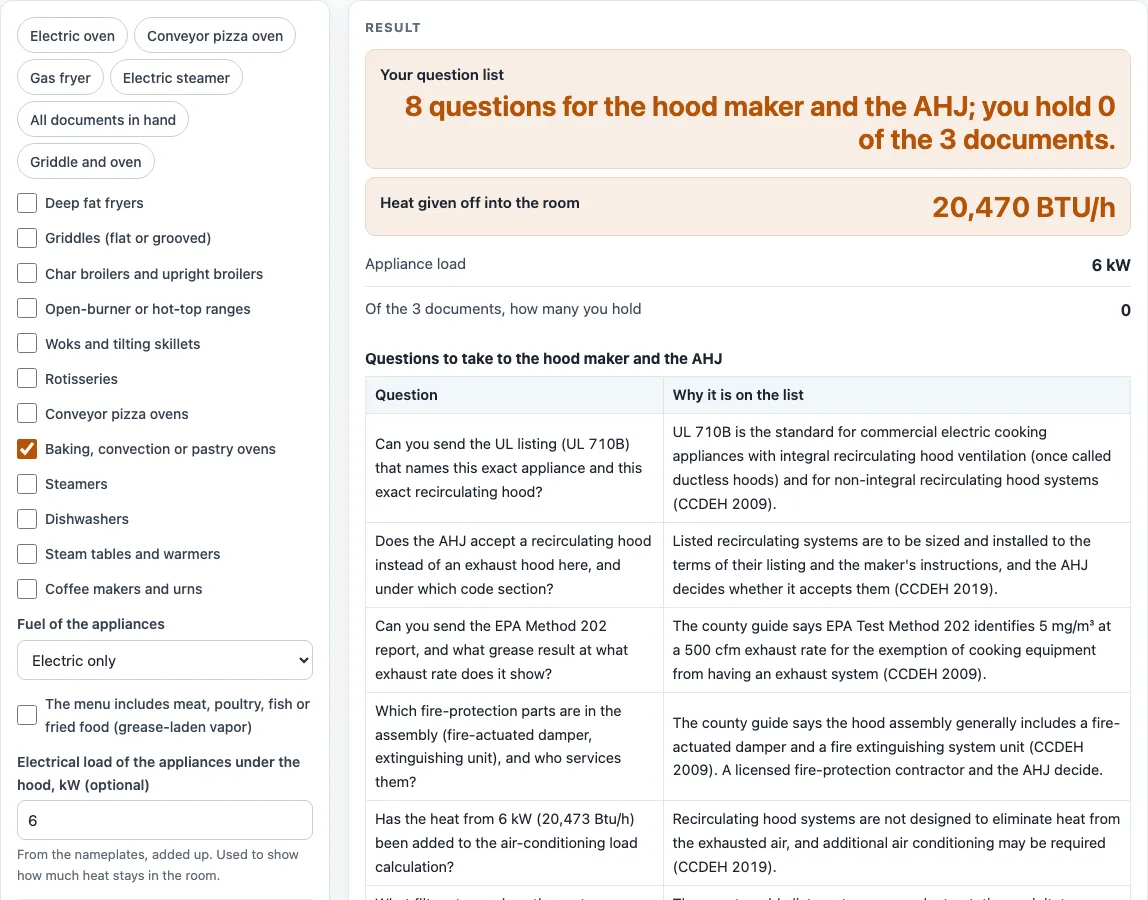
- Pick a preset, or start from the default: an electric oven at 6 kW with no documents held.
- Choose your appliance from the 12 appliance categories.
- Set “Fuel” to electric only, gas or other fuel, or a mix.
- Tick whether your menu includes meat, poultry, fish or fried food.
- Enter the appliance load in kW if you know it. This field is optional. The tool converts the load to heat in Btu/h.
- Tick any documents you already hold: the UL 710B listing, the EPA 202 report, or AHJ acceptance in writing.
- Read the question list. Ticking a document removes the question it answers and adds a question about keeping the written acceptance with the listing.
- Read any warnings. They appear for non-electric fuel, for menus with grease, and for a listing without an EPA 202 report.
- Check the heat figure. If you entered a load, the result “Heat given off into the room” shows it in Btu/h, because the sources say a recirculating hood is not designed to remove heat.
- Take the final question list to the hood maker and the AHJ. The result “Of the 3 documents, how many you hold” shows how many of the three documents you ticked.
The presets are electric oven, conveyor pizza oven (18 kW, grease), gas fryer, electric steamer (3 kW), all documents in hand, and griddle and oven (mixed fuel, 9 kW). Each one fills in the inputs so you can compare how the question list changes.
What is a ventless hood?
A ventless hood is a recirculating hood system. It is a self-contained air system that filters kitchen air and returns it to the facility instead of venting it outside through ducts. Grease and smoke are usually removed by water sprays, electrostatic precipitators or multiple filter banks, and odors are usually removed by activated charcoal.
Which test standards apply to a ventless hood?
UL 710B covers commercial electric cooking appliances with integral recirculating hood ventilation and non-integral recirculating hood systems. The assembly generally includes a fan, a collection hood, an air filtering system, a fire-actuated damper and a fire extinguishing system unit. UL categories KNKG and YZCT certify these systems, according to the CCDEH 2009 and 2019 sources. Sources differ on scope: the 2009 guide describes UL 710B for electric appliances, while some listings on the market fall in other categories, such as KNLZ and KNKG. For that reason, the tool asks you to confirm what your listing covers.
How is grease tested for a ventless hood?
EPA Test Method 202 measures condensable particulate, which is grease. The 2009 guide says this test is used to exempt cooking equipment from having an exhaust system. The guide gives 5 mg/m3 at a 500 cfm exhaust rate as its figure. These are the guide’s numbers, and the tool quotes them with that attribution. The food used in the test matters, so the tool asks which food was used.
Why does a ventless hood add heat to the room?
A recirculating hood does not remove heat from the exhausted air. The CCDEH 2019 source says additional air conditioning may be required. The tool converts the appliance electrical load to heat using Btu/h = kW x 3,412.14. For example, a 6 kW appliance gives about 20,470 Btu/h. That figure is calculated from the value you enter. It is an example, not a code value.
Why do the questions change with your answers?
The tool always asks about the UL 710B listing for your exact appliance and hood, fire-protection parts and who services them, filter stages and change intervals, and how many appliances of what size the listing covers. Other questions are added based on fuel, menu, load, and cooking method. Ticking the listing, EPA report, or AHJ boxes removes the questions you have already answered. A gas fryer with a grease menu and no kW entry produces 9 questions. Three documents held produces 7 questions.
Worked examples
| Input | Result |
|---|---|
| 1 appliance categories, electric only | 8 questions for the hood maker and the AHJ; you hold 0 of the 3 documents. |
| 1 appliance categories, electric only | 9 questions for the hood maker and the AHJ; you hold 0 of the 3 documents. |
| 1 appliance categories, gas or other fuel | 9 questions for the hood maker and the AHJ; you hold 0 of the 3 documents. |
| 1 appliance categories, electric only | 7 questions for the hood maker and the AHJ; you hold 3 of the 3 documents. |
Calculated by the tool above; open it with the same values to see each step.
Frequently asked questions
Is a ventless hood allowed in my kitchen?
The tool does not give a verdict, and this page does not say where a ventless hood is allowed. Take the listing and your questions to your authority having jurisdiction (AHJ).
Does a ventless hood replace an exhaust hood?
The page does not say it does. Put that question to the hood maker and the AHJ, with the listing in hand.
What does my UL 710B listing cover?
Ask the hood maker for the exact scope. The 2009 guide describes UL 710B for electric appliances.
Can I use a ventless hood with gas cooking?
The tool does not answer this. The 2009 guide describes UL 710B for electric appliances, so the tool shows a warning for gas or other fuels. Ask the hood maker and the AHJ whether your listing covers your fuel.
Are the results a stamped engineering document?
No. Results are calculated from the values and factors you enter, or they state what the named source says. They do not replace a licensed engineer, the hood maker’s instructions, or the AHJ.
What does the EPA 202 test measure?
EPA Test Method 202 measures condensable particulate, which is grease. The 2009 guide uses it to exempt cooking equipment from having an exhaust system, and it gives 5 mg/m3 at 500 cfm as its figure.
Related tools
- Kitchen Hood CFM Calculator: Use it when you want to work through airflow for a standard kitchen exhaust hood.
- Commercial Kitchen Hood Sizing Worksheet: Use it to step through hood size for a commercial kitchen layout.
- Exhaust Hood Calculator: Use it to estimate exhaust values for a ducted hood.
- Type 1 Hood: Read this when you need the basics of Type 1 hoods for grease-producing appliances.
- Type 1 vs Type 2 Hood: Read this to compare the two hood types side by side.
- Type 2 Hood: Read this for the basics of Type 2 hoods for heat and steam appliances.
- Commercial Kitchen Hoods: Read the hub page that groups the hood tools and guides.
- Hood Requirements Checklist: Use it to list the questions to take to your AHJ.
- NFPA 96 Overview: Read it for a plain-language overview of the standard.