Type 2 Hood
Tick the appliances to see how public sources classify them, then enter the hood length or face area for the exhaust cfm of a condensate hood.
Recent
Your last 10 settings, saved only in this browser. Nothing is uploaded.
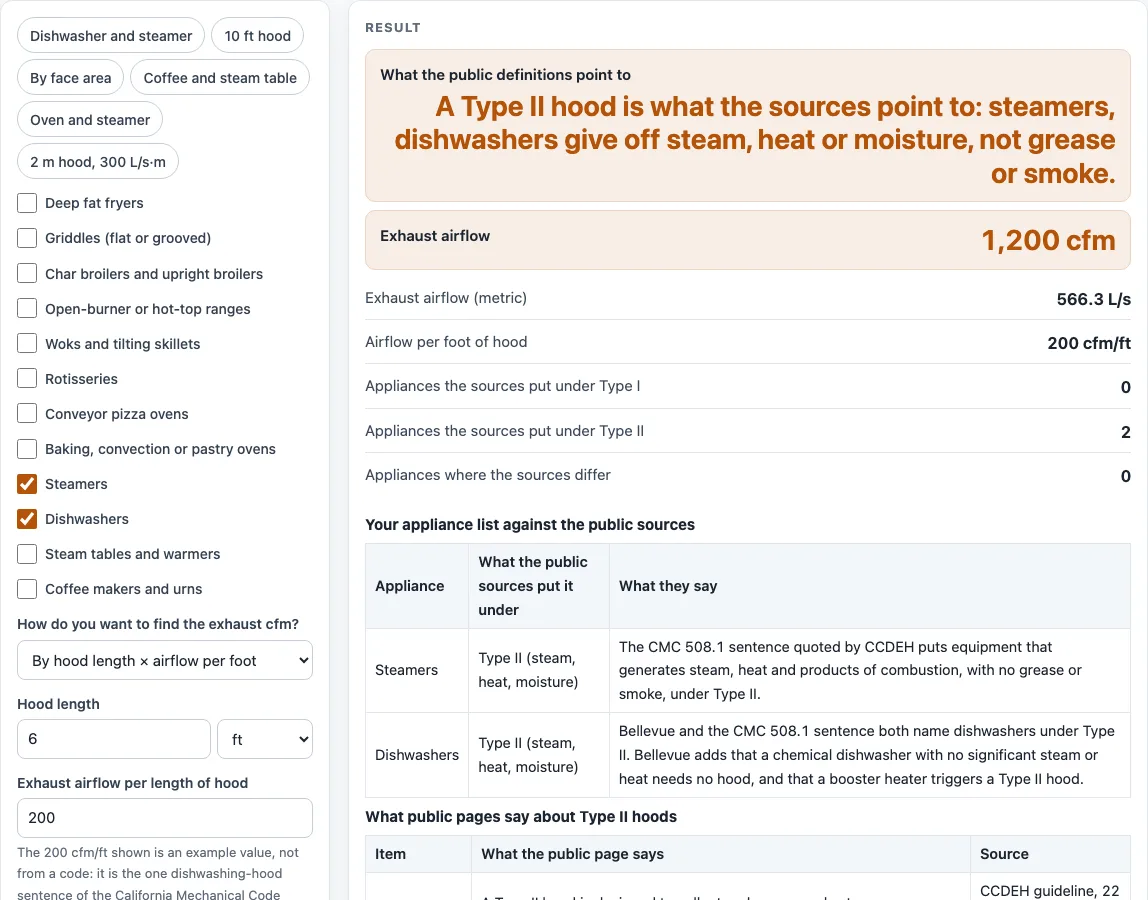
How to use the Type 2 Hood Selector and Worksheet
- Open the selector and tick each appliance category in your kitchen. The categories are steamers, dishwashers, steam tables and warmers, coffee makers and urns, and ovens, among the 12 shown.
- Check the counts for Type I, Type II and “sources differ”. Ovens show as “the sources differ”. Any category the sources put under Type I triggers a warning.
- Read the line “what the public definitions point to”. It is a starting point, never a verdict. The AHJ makes the decision.
- Open the worksheet and choose a method: “hood length x airflow per foot” or “face area x face velocity”.
- For “hood length x airflow per foot”, enter the hood length in feet and the rate as cfm/ft or L/s per m. Rates under 20 or over 1,000 cfm/ft produce a warning.
- For “face area x face velocity”, enter the face width and height in ft, in, m or mm, and the velocity in ft/min or m/s. The tool uses Q = V x A.
- Read the airflow result. With the default example of a dishwasher and steamer, 6 ft and 200 cfm/ft give 1200 cfm (566.3 L/s).
Six presets give you starting points: dishwasher and steamer; 10 ft hood; by face area; coffee and steam table; oven and steamer; and 2 m hood at 300 L/s per m. Pick the one closest to your kitchen, then change the values to match your own equipment and hood.
What is a type 2 hood?
A Type II hood is a hood designed to collect and remove only steam, vapors, heat or odors, according to the CCDEH 2019 definition. The CEC 2019 guide uses it for steam removal, and an ACCA blog from 2017 says these hoods are “often called condensate hoods” that “don’t require fire protection.” The label matters because Type I hoods are the category for grease and smoke, so the distinction affects which hood and duct rules apply, and the AHJ decides which ones apply.
Where does a Type II hood go?
The California Mechanical Code 508.1, as the county guideline quotes it, places these hoods above equipment and dishwashers that produce steam, heat and products of combustion where grease or smoke is not present. Bellevue adds that operations producing significant steam or heat but no grease or smoke need a Type II hood or may be handled by the HVAC system. Bellevue also says a Type II hood may need a plaque stating that cooking causing grease-laden vapors is not allowed and that the hood is for steam and heat removal only. Ovens are the one category where the sources disagree: Bellevue places them under Type 2, while the CMC 508.1 sentence lists them under Type I. The tool marks them “the sources differ” rather than picking one side.
How is the exhaust airflow worked out?
The worksheet uses two methods. “Hood length x airflow per foot” multiplies the hood length by a rate per foot. The 200 cfm/ft default is an example value, not a code number. It comes from the one dishwashing-hood sentence in California Mechanical Code 508.10.1.6 as the county guideline quotes it, and other places word their rates differently.
“Face area x face velocity” uses Q = V x A, where Q is airflow, V is face velocity and A is face area. The 100 ft/min default is a laboratory fume-hood figure from one university, not a kitchen value, so type your own. Either way, the output is calculated from the values you enter.
Does a type 2 hood need a grease duct?
The pages read do not say whether a Type II hood needs a grease duct. The county guideline’s duct section covers ducting for both hood types but writes its velocity limits for Type I, and it tells you to ask the AHJ. Do not assume either answer. Put the question to the AHJ before you finalize a design.
Worked examples
| Input | Result |
|---|---|
| 2 appliance categories, hood length × airflow per foot | 1,200 cfm (566.3 L/s) |
| 2 appliance categories, hood length × airflow per foot | 1,600 cfm (755.1 L/s) |
| 2 appliance categories, face area × face velocity | 1,200 cfm (566.3 L/s) |
| 3 appliance categories, hood length × airflow per foot | 1,271 cfm (600 L/s) |
Calculated by the tool above; open it with the same values to see each step.
Frequently asked questions
Can I use the result as proof that my hood is approved?
No. The result is calculated from the values and factors you enter and is not a stamped engineering document. Only the AHJ decides how a hood design is handled in your jurisdiction.
Will a Type II hood need a plaque?
Bellevue says a Type II hood may need a plaque stating that cooking causing grease-laden vapors is not allowed and that the hood is for steam and heat removal only. Ask the AHJ whether your installation needs one.
Do dishwashers always need a Type II hood?
No. Bellevue says a chemical dishwasher with no significant steam or heat needs no hood, while a booster heater triggers a Type II hood. The county guideline lists a UL 921 condensing dishwasher as an exception when the HVAC is engineered for its heat load.
Why does the rate default to 200 cfm/ft?
It is an example value, not from a code. It is taken from the one dishwashing-hood sentence in California Mechanical Code 508.10.1.6 as the county guideline quotes it. Other jurisdictions and IMC editions word their rates differently, so use the rate your AHJ or engineer specifies.
Why does the face velocity default show 100 ft/min?
It is a laboratory fume-hood figure from one university, not a kitchen value. It is included only as an example, so replace it with the velocity your hood maker or engineer specifies.
Does this tool work the same in every jurisdiction?
No. The classifications and rates come from the sources named on this page, and other jurisdictions may classify equipment or word their rates differently. Check your local AHJ before relying on any figure.
Related tools
- Kitchen Hood CFM Calculator: use it for a separate airflow estimate for a commercial hood.
- Commercial Kitchen Hood Sizing Worksheet: use it to work through hood size and airflow step by step.
- Exhaust Hood Calculator: use it for a general exhaust airflow estimate from hood dimensions.
- Type 1 Hood: read it to learn about the hood category for grease and smoke.
- Type 1 vs Type 2 Hood: use it to compare the two categories side by side.
- Ventless Hood Guide: read it if you are looking at hood options that do not use a conventional exhaust duct.
- Commercial Kitchen Hoods: read the hub page that groups the hood tools and guides.
- Hood Requirements Checklist: use it to list the questions to take to your AHJ.
- NFPA 96 Overview: read it for a plain-language overview of the standard.