Type 1 vs Type 2 Hood
Answer five yes or no questions about grease, smoke, steam and fuel to see which hood type public definitions point to, then compare the two side by side.
Recent
Your last 10 settings, saved only in this browser. Nothing is uploaded.
How to use the Type 1 vs Type 2 Hood tool
- Open the tool at the top of this page. Five yes/no questions appear.
- Answer question 1: does an appliance make grease-laden vapor or smoke?
- Answer question 2: is any solid-fuel cooking done?
- Answer question 3: does any appliance give off only steam, heat or moisture?
- Answer question 4: is there a dishwasher?
- Answer question 5: is there a gas or other fuel-burning appliance?
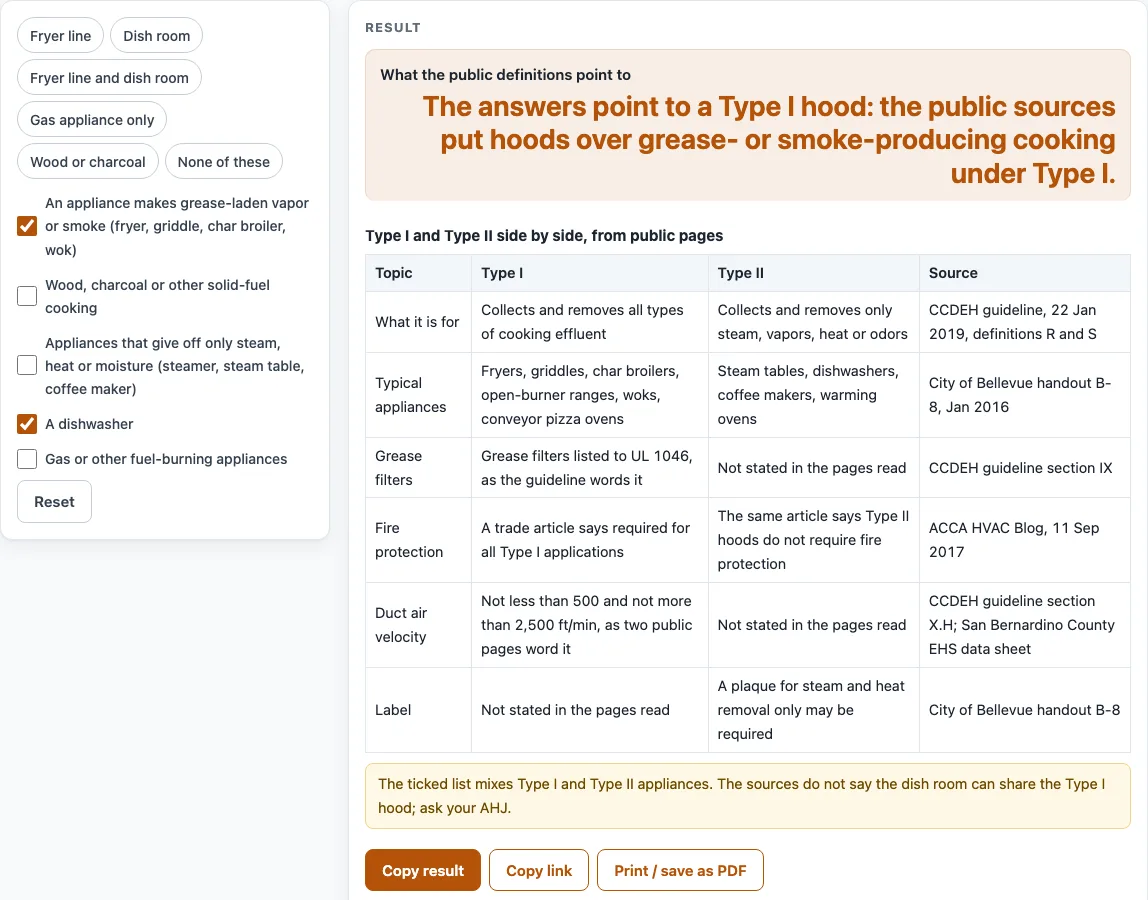
- Read the line “What the public definitions point to”. The rules are checked in order. Grease or solid fuel gives Type I. Otherwise, steam, heat or a dishwasher gives Type II. Otherwise, a fuel-burning appliance gives “a hood system, ask the AHJ”. If none of these apply, you get “neither hood type, ask the AHJ”.
- Read any warning shown with the verdict. Warnings explain where the sources are unclear or where your list mixes appliance types.
- Compare the side-by-side table, which has six rows, to see how the two hood types differ.
- To save time, pick a preset: “fryer line”, “dish room”, “fryer line and dish room”, “gas appliance only”, “wood or charcoal”, or “none of these”. Then change any answer that does not match your kitchen.
- Read the last step of every answer: “This is an indication from public definitions. Your authority having jurisdiction (AHJ) decides the hood type.”
Presets are the only shortcut: pick one, then change the answers to match your kitchen.
What is the difference between a Type 1 and a Type 2 hood?
Type I hoods are for cooking operations that produce grease or smoke. Type II hoods are for operations that produce significant steam or heat but no grease or smoke. This is the core split in Bellevue handout B-8, and the CCDEH 2019 definitions (R and S) describe the same division. For appliance lists and exhaust cfm worksheets, see the Type 1 hood page and the Type 2 hood page.
The table in the tool compares the two types on six points. Type I hoods use grease filters listed under UL 1046, while the pages read do not state a grease filter standard for Type II. A trade article says fire protection is required for Type I and not for Type II. Two public pages give a duct air velocity of 500 to 2,500 ft/min for Type I, and no figure is stated for Type II. One city’s handout mentions a label, a plaque for Type II. These are what the named sources say, not a check of any installed hood.
How does the tool decide between the two hood types?
The tool works like a priority list, not a total. The first matching rule sets the verdict. Any grease or solid-fuel appliance is enough for Type I, even if steam appliances or a dishwasher are also present. Steam, heat or a dishwasher, with no grease or solid fuel, gives Type II. A fuel-burning appliance with neither of those gives “a hood system, ask the AHJ”. When nothing is ticked, the verdict is “neither hood type, ask the AHJ”, with a warning. The page does not say that no hood is needed. Bellevue’s examples of appliances without a hood are small units under 6 kW in one room.
Some combinations produce warnings. The default, with grease and a dishwasher ticked, points to Type I. The warning notes that the list mixes Type I and Type II appliances, and that the sources do not say a dish room can share the Type I hood. Solid fuel alone gives Type I with a warning that it is the heaviest case. Bellevue lists solid-fuel extra-heavy-duty appliances, barbecue pits and grease-burning char broilers as needing a separate hood and grease duct. Ovens are not one of the five questions because the sources differ on them, and the Type I and Type II pages cover them.
Worked examples
| Input | Result |
|---|---|
| 2 question(s) answered yes | The answers point to a Type I hood: the public sources put hoods over grease- or smoke-producing cooking under Type I. |
| 1 question(s) answered yes | The answers point to a Type II hood: the public sources put steam, heat and moisture without grease or smoke under Type II. |
| 1 question(s) answered yes | The answers point to a hood system for the fuel-burning appliance. Whether it is Type I or Type II depends on what is cooked; ask your AHJ. |
| 1 question(s) answered yes | The answers point to a Type I hood: the public sources put hoods over grease- or smoke-producing cooking under Type I. |
| 0 question(s) answered yes | The answers point to neither hood type. Ask your AHJ before assuming no hood is needed. |
Calculated by the tool above; open it with the same values to see each step.
Frequently asked questions
Can I use this result for a permit?
No. The result is an indication from public definitions. It is not a stamped engineering document, and it does not replace your AHJ, a licensed engineer or the hood maker’s instructions.
Why does the tool say “neither hood type, ask the AHJ”?
This verdict appears when no grease, solid-fuel, steam, heat, dishwasher or fuel-burning appliance is ticked. It does not mean no hood is needed. Bring the appliance list to your AHJ.
Can a dishwasher share a Type I hood?
The sources read for this tool do not say so. The tool shows a warning in this case. Ask your AHJ or a licensed engineer.
Are ovens included in the five questions?
No. The sources differ on ovens, so the tool leaves them out. Check the Type 1 hood page and the Type 2 hood page for how each treats them.
Does a Type II hood need grease filters?
The pages read do not state a grease filter rule for Type II. Type I grease filters are listed under UL 1046. Check the hood maker’s instructions and ask your AHJ.
Does the tool calculate exhaust rates?
No. The tool gives no exhaust-rate numbers. For exhaust cfm worksheets, use the linked hood pages or the calculators listed below.
Related tools
- Kitchen Hood CFM Calculator: use it to work through airflow values once you know the hood type.
- Commercial Kitchen Hood Sizing Worksheet: use it as a teaching worksheet for sizing a commercial hood.
- Exhaust Hood Calculator: use it to estimate exhaust values from the figures you enter.
- Type 1 Hood: use it for Type I appliance lists and exhaust worksheets.
- Type 2 Hood: use it for Type II appliance lists and exhaust worksheets.
- Ventless Hood Guide: use it to compare ventless options with ducted hoods.
- Commercial Kitchen Hoods: read the hub page that groups the hood tools and guides.
- Hood Requirements Checklist: use it to list the questions to take to your AHJ.
- NFPA 96 Overview: read it for a plain-language overview of the standard.