Type 1 Hood
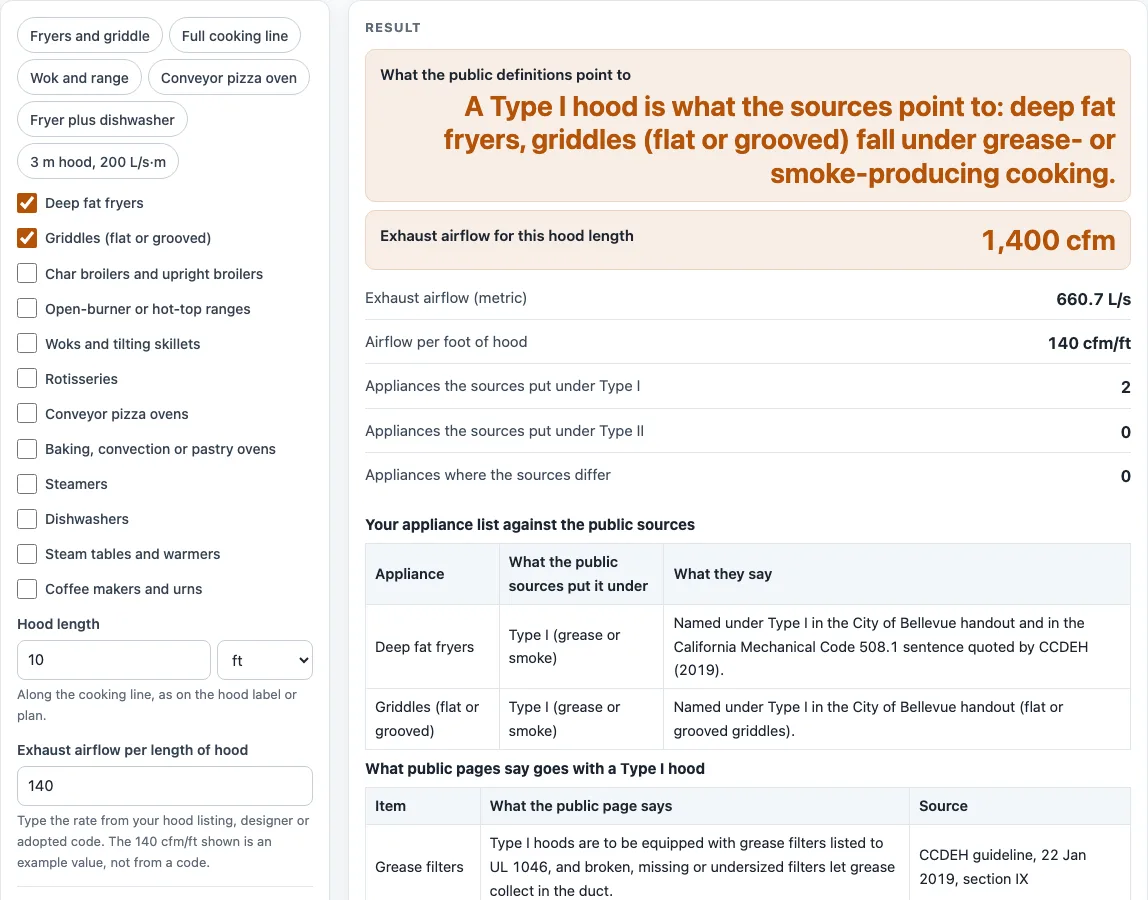
Tick the appliances under the hood to see how public sources classify them, then enter the hood length and rate for the exhaust cfm.
Recent
Your last 10 settings, saved only in this browser. Nothing is uploaded.
How to use the type 1 hood selector
- Look at the list of 12 appliance categories under the hood.
- Tick each appliance you plan to put under the hood. Leave out anything that will not go under it.
- Or start from a preset: “Fryers and griddle”, “Full cooking line”, “Wok and range”, “Conveyor pizza oven”, “Fryer plus dishwasher” or “3 m hood, 200 L/s·m”. Deep fat fryers and griddles are ticked by default.
- Read “What the public definitions point to”. It reports Type I, Type II or where the sources differ, and it reflects what the sources point to. The note under the result says the AHJ decides.
- Check the warnings. They appear if nothing is ticked, if none of the ticked appliances is put under Type I by the sources, or if the list mixes types.
- Enter the “Hood length” in the worksheet. The default is 10 ft.
- Enter the “Exhaust airflow per length of hood”. The default is 140 cfm/ft, which gives 1400 cfm (660.7 L/s). The 140 is an example value, not a code figure. You can type the rate in cfm/ft or L/s per m. Rates under 20 or over 1,000 cfm/ft trigger a warning.
- Read the table “What public pages say goes with a Type I hood”.
Presets are the quickest way to compare a common setup. Change one tick at a time to see how the indication and the worksheet result move.
What is a Type I hood?
A Type I hood is designed to collect and remove all types of cooking effluent, according to the CCDEH 2019 definition. The CEC 2019 guide describes it as the hood used for greasy smoke removal. Washington State’s amended IMC (section 507.2) installs it where cooking produces grease or smoke, and over medium-, heavy- and extra-heavy-duty appliances.
Which appliances do the sources put under a Type I hood?
The sources place deep fat fryers, griddles, char broilers and upright broilers under Type I. They also list open-burner or hot-top ranges, woks and tilting skillets, rotisseries and conveyor pizza ovens. City of Bellevue handout B-8 adds that solid-fuel and grease-burning char broilers need a separate hood and grease duct. Steamers, dishwashers, steam tables, warmers and coffee makers are shown under Type II, which covers steam, heat and moisture.
How is hood airflow calculated in the worksheet?
The worksheet multiplies the hood length by the airflow per foot. A 10 ft hood at 140 cfm/ft gives 1,400 cfm. Since 1 cfm equals about 0.4719 L/s, that is about 660.7 L/s. The 140 cfm/ft value is an example, so replace it with the figure from your own design or your engineer’s instructions. For a metric hood, enter the rate in L/s per m. The “3 m hood at 200 L/s per m” preset gives 600 L/s on the same basis. The page does not size ducts or fans, and it gives no clearances.
Why do the sources disagree about some appliances?
Baking, convection and pastry ovens are the main example. City of Bellevue lists them under Type II. The California Mechanical Code 508.1 sentence quoted by the CCDEH guideline lists ovens with the Type I equipment. The page marks these as “where the sources differ” instead of choosing one. The section numbers also vary by jurisdiction: the IMC calls the rule 507.2 in the Washington amendment, while the California Mechanical Code calls it 508.1. When the sources differ, ask your AHJ which rule applies to your oven.
What else do public pages list with a Type I hood?
The table on the page gathers items that public pages mention, without saying what your project needs. They include grease filters listed to UL 1046, fire protection that a trade article says is required for all Type I applications, and duct air velocity written as not less than 500 and not more than 2,500 ft/min. They also include a separate duct system for each Type I hood, with a stated exception, and make-up air tied to the exhaust on one county’s data sheet. Treat each row as a question to take to your AHJ, a licensed fire-protection contractor and the hood maker.
Worked examples
| Input | Result |
|---|---|
| 2 appliance categories, 10 ft of hood | 1,400 cfm. A Type I hood is what the sources point to: deep fat fryers, griddles (flat or grooved) fall under grease- or smoke-producing cooking. |
| 3 appliance categories, 12 ft of hood | 1,680 cfm. A Type I hood is what the sources point to: deep fat fryers, griddles (flat or grooved), char broilers and upright broilers fall under grease- or smoke-producing cooking. |
| 3 appliance categories, 10 ft of hood | 1,400 cfm. A Type I hood is what the sources point to: deep fat fryers, griddles (flat or grooved) fall under grease- or smoke-producing cooking. |
| 1 appliance categories, 3 m of hood | 1,271 cfm. A Type I hood is what the sources point to: deep fat fryers fall under grease- or smoke-producing cooking. |
Calculated by the tool above; open it with the same values to see each step.
Frequently asked questions
Does a result from this tool tell me whether my hood design is accepted?
No. The page gives no verdict. The result is calculated from the values and factors you enter, or it reports what a named source says. It is not a stamped engineering document and does not replace a licensed engineer, the hood maker’s instructions or your AHJ.
What does “where the sources differ” mean?
It means the public sources do not agree on that appliance. Ovens are the clearest case, so check the category with your AHJ before you plan the hood.
What happens if I tick nothing?
The page shows a warning instead of an indication. Tick the appliances you plan to cook on to see what the sources point to.
Can I enter metric values?
Yes. You can type the airflow rate in cfm/ft or in L/s per m. The worksheet shows the result in both cfm and L/s.
Does the tool size ducts, fans or fire suppression?
No. The page does not size ducts, fans or fire suppression, and it gives no clearances. The table of related items lists what public pages say goes with a Type I hood, but a licensed fire-protection contractor and your AHJ decide on fire protection.
Is my data uploaded anywhere?
No. The tool runs in your browser, and nothing you enter is uploaded. You do not need to sign up.
Related tools
- Kitchen Hood CFM Calculator: use it to compare airflow estimates for a commercial kitchen hood.
- Commercial Kitchen Hood Sizing Worksheet: use it when you want to work through hood length and airflow step by step.
- Exhaust Hood Calculator: use it for a general exhaust airflow estimate.
- Type 1 vs Type 2 Hood: use it to see how the two hood types differ.
- Type 2 Hood: use it to learn about the hood type for steam, heat and moisture.
- Ventless Hood Guide: use it to learn about ventless hoods and how they differ from ducted ones.
- Commercial Kitchen Hoods: the hub page for all hood tools and guides.
- Restaurant Hood Requirements Checklist: use it to list questions to take to your AHJ.
- NFPA 96 Overview: use it as a chapter finder and a list of questions for your AHJ.