Range Hood CFM Calculator
Enter the cooktop and the duct run to see the target cfm, the duct pressure and the rated cfm to look for after the hood is derated.
Recent
Your last 10 settings, saved only in this browser. Nothing is uploaded.
How to use the Range Hood CFM Calculator
- Choose the cooktop type. Gas uses the Btu/h method or the width method. Electric or induction uses the width method only.
- For gas, enter the “gas Btu/h” of the cooktop. The default is 50,000 Btu/h.
- Enter the “cooktop width” and choose wall or island. The default is a 30 in. wall range.
- Enter the duct inputs: “Round duct diameter”, “Straight duct length”, “Number of elbows” and “Duct material”.
- Check the loss values: “Loss coefficient per elbow (C)”, “Loss coefficient of the wall cap or damper (C)” and “Other pressure losses (in. w.g.)”. The elbow value defaults to 0.3 and the cap value to 0.
- Enter the hood’s own derating points from its performance table: “Hood rating pressure” (default 0.1 in. w.g.), “A second pressure on the hood’s performance table” (default 0.5 in. w.g.) and the airflow percent at that second pressure (default 75 %).
- Optional: type “Your hood’s rated airflow” to see how much air it would deliver through your duct.
- Read the target cfm, the total duct pressure and the “rated airflow to look for”. Then check any warnings or errors.
Under “More options” you can pick the gas method, choose cfm, L/s or m³/h for airflow, and choose ft, in, m or cm for lengths.
How much airflow does a range hood need over a cooktop?
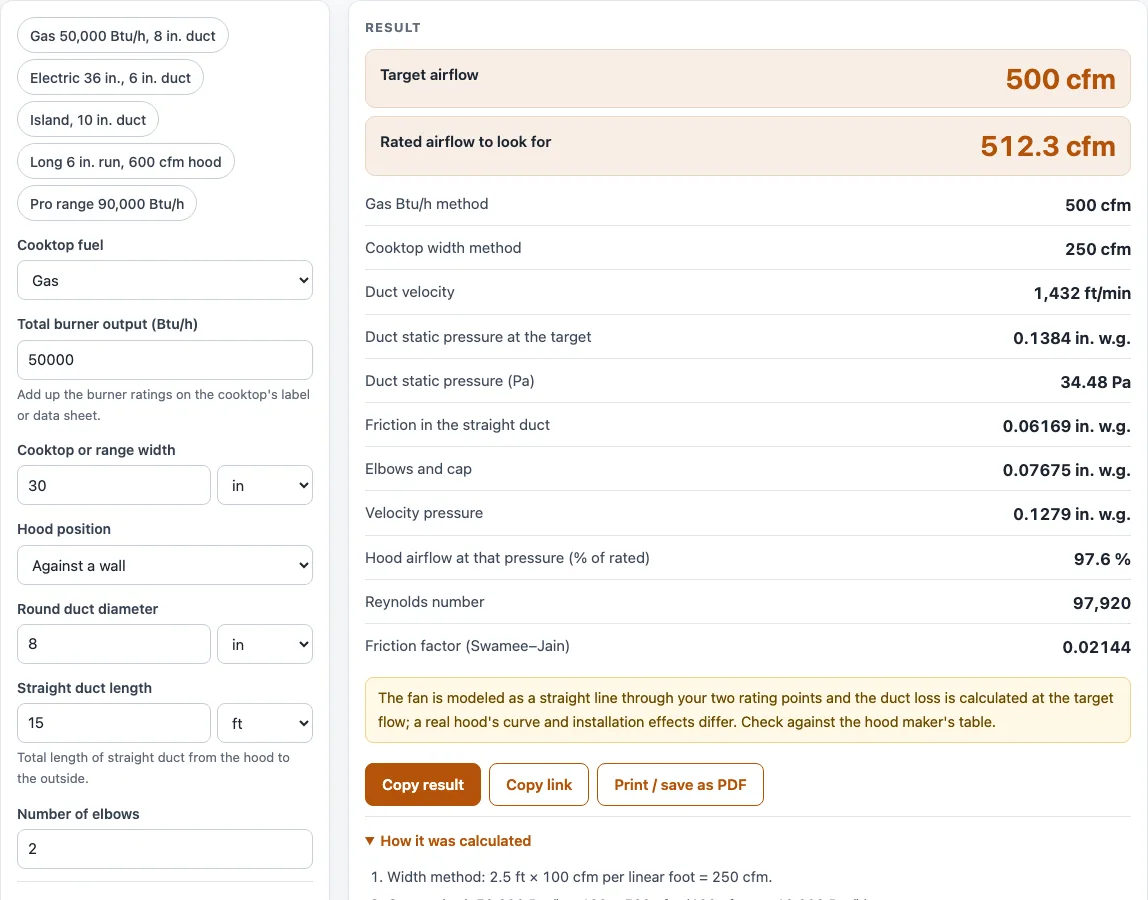
The tool sets a target cfm in two ways. For gas, it divides the Btu/h by 100, using a maker guide’s rate of 100 cfm per 10,000 Btu/h. The width method multiplies the cooktop width in feet by 100 cfm for a wall hood or 150 cfm for an island, using HVI recommended rates quoted in a Penn State brief. For gas, the larger result is used unless you pick a method under “More options”. The default 50,000 Btu/h gives 500 cfm, and a 30 in. wall width gives 250 cfm, so the target is 500 cfm. Another source suggests a much higher figure for gas island cooktops. The tool uses only the maker guide, so the sources differ and the result depends on which one you trust.
How is duct static pressure calculated for a range hood?
Duct pressure is found step by step. Velocity is V = Q ÷ A, where Q is the airflow and A is the duct area. Velocity pressure is VP = (V ÷ 4005)² in. w.g. at standard air. Friction loss is f × (L ÷ D) × VP, using the Darcy–Weisbach method. The friction factor f comes from the Swamee–Jain equation, which approximates Colebrook–White. Fittings loss is (elbows × C + cap C) × VP. The Reynolds number uses a kinematic viscosity of 1.51 × 10⁻⁵ m²/s for air at 20 °C.
A heavy example is 500 cfm in a 6 in. duct, 30 ft long, with 4 elbows. The velocity is 2,546 ft/min and the total loss is 1.013 in. w.g. (252.4 Pa). Longer, smaller ducts with more elbows raise this total quickly.
Why does a range hood deliver less air as duct pressure rises?
The tool models the hood’s fan as a straight line through two points you type: the rating pressure at 100 % and the second pressure at the airflow percent you enter. The line is capped at 100 %. The derating is the line’s value at the duct’s total static pressure. This is a simplification, because real fan curves are not always straight, and the friction at the target flow is also estimated. The tool shows an error if the second pressure is not above the first, if the airflow percent is above 100, or if the duct pressure is so high that the line reaches zero airflow.
What rated cfm should I look for on a hood’s table?
The rated airflow to look for equals the target cfm divided by the derating. With the default values, the derating is 97.6 % at 0.1384 in. w.g., so you look for 512.3 cfm. In the heavy example, the derating is 42.9 %, so you look for 1,165 cfm. The tool gives warnings when the delivered airflow is under half of the rated airflow and when the duct pressure is above the second point you typed. The tool uses no brand data and no code table, so the rated cfm for a particular hood must come from that hood’s performance table.
Worked examples
| Input | Result |
|---|---|
| 30 in cooktop, 8 in duct, 15 ft, 2 elbows | target 500 cfm, duct 0.138 in. w.g., rated airflow to look for 512.3 cfm |
| 36 in cooktop, 6 in duct, 10 ft, 1 elbows | target 300 cfm, duct 0.11 in. w.g., rated airflow to look for 301.9 cfm |
| 36 in cooktop, 10 in duct, 25 ft, 3 elbows | target 600 cfm, duct 0.115 in. w.g., rated airflow to look for 605.8 cfm |
| 30 in cooktop, 6 in duct, 30 ft, 4 elbows | target 500 cfm, duct 1.01 in. w.g., rated airflow to look for 1,165 cfm |
Calculated by the tool above; open it with the same values to see each step.
Frequently asked questions
Is the range hood cfm calculator free to use?
Yes. It runs in your browser, nothing is uploaded, there is no sign-up, and the tool is free.
Does a result tell me whether my range hood installation is acceptable?
No. A result is calculated from the values and factors you enter. It is not a stamped engineering document, and it does not replace a licensed engineer, the hood maker’s instructions or the authority having jurisdiction (AHJ).
Why does the target cfm change between gas and electric?
For electric or induction cooktops, the tool uses the width method only, because the Btu/h method needs a gas input. For gas, it uses the larger of the two methods unless you choose one under “More options”.
Where does the 0.3 elbow value come from?
It is an example. One public pipe-fitting table lists 0.3 for a regular flanged 90° elbow, which is not a duct elbow value. The cap value defaults to 0 because no public figure was read. Enter values from your own duct fitting source.
Why do I see a warning about a Reynolds number below 5,000?
The friction formula is meant for turbulent flow, and a low Reynolds number means the flow may not be turbulent. Check the duct size and airflow you entered.
Can I see airflow in L/s or m³/h instead of cfm?
Yes. Under “More options” you can choose cfm, L/s or m³/h for airflow, and ft, in, m or cm for lengths.
Related tools
- Air Changes per Hour Calculator: use it to compare room air changes with the airflow you are planning.
- Kitchen Exhaust Fan Size Calculator: use it when you are sizing the whole exhaust fan for a kitchen.
- Make Up Air for a Range Hood: read it when you need to plan the air that replaces what the hood removes.
- Heated Make Up Air Unit Calculator: use it to estimate heating for make up air supplied to the kitchen.
- Make Up Air Unit for Kitchen Hood: read it when you are comparing make up air units for a kitchen hood.
- Make-Up Air, Air Changes and Kitchen Exhaust: browse the whole group of replacement air and exhaust worksheets.
- Static Pressure Calculator: use it to add up duct friction and fitting losses for other runs.
- Duct Velocity Calculator: use it to relate airflow to duct size and velocity.
- Kitchen Hood CFM Calculator: use it to estimate exhaust cfm by hood length.