Heated Make Up Air Unit Calculator
Enter the airflow, the outdoor and supply temperatures, the efficiency and the gas heating value to see the load in Btu/h and kW, the burner input and the gas flow.
Recent
Your last 10 settings, saved only in this browser. Nothing is uploaded.
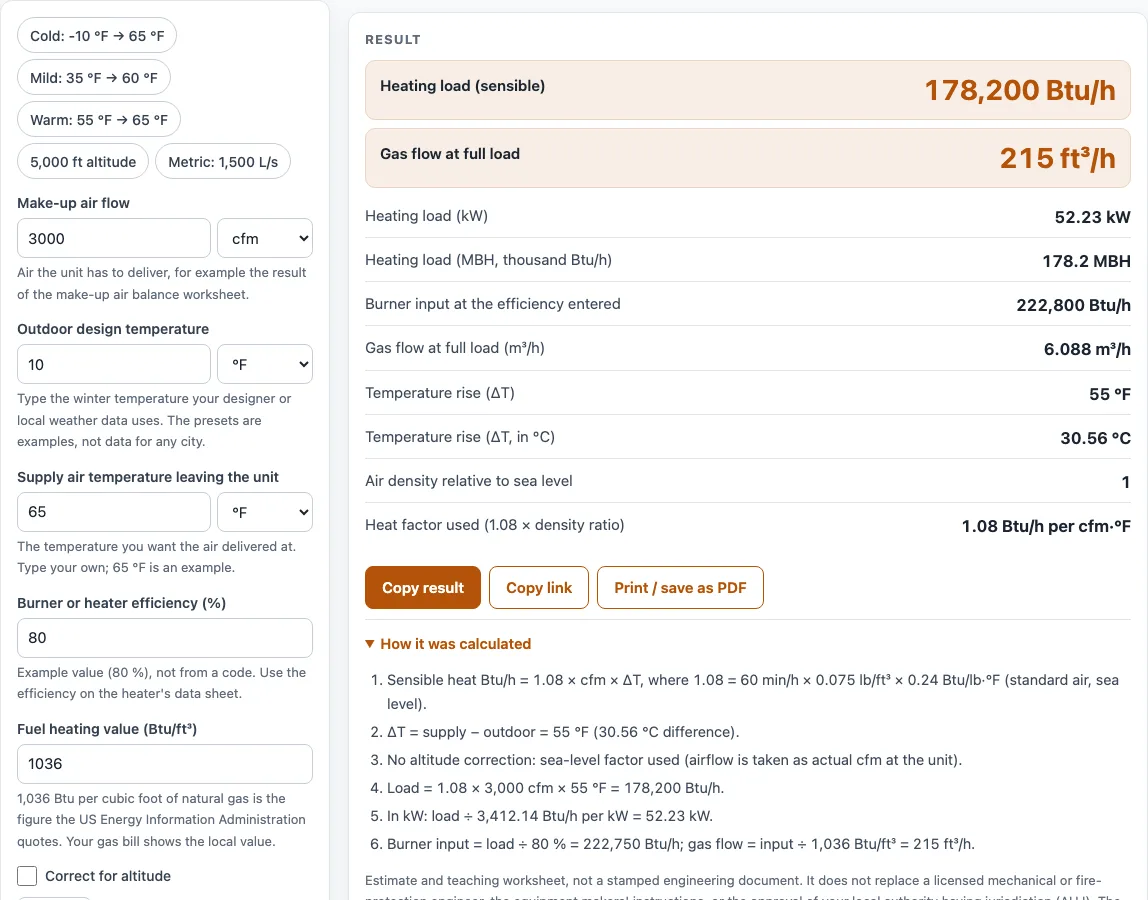
How to use the Make-Up Air Heating Calculator
- Enter the “Make-up air flow” in cfm, L/s or m³/h.
- Enter the “outdoor design temperature” in °F or °C. The two temperatures can use different units.
- Enter the “Supply air temperature leaving the unit”, the temperature of the air leaving the heater. If it is not above the outdoor temperature, the page shows zero load and says so. A warning appears above 120 °F because that value is unusual.
- If your site is at altitude, tick “Correct for altitude” and enter the “Altitude above sea level”. The model is valid from −400 m to 11,000 m, and the page asks for a different altitude outside that range.
- Enter the “Burner or heater efficiency (%)” from the heater’s data sheet. The 80 % default is only an example.
- Enter the “Fuel heating value (Btu/ft³)”. The default of 1,036 Btu/ft³ is the US EIA figure for natural gas. Check your gas bill for the real value. Propane or other fuels need their own heating value.
- Read the “Heating load (sensible)” (Btu/h and MBH), the “Heating load (kW)”, the “Burner input at the efficiency entered” and the “Gas flow at full load” in ft³/h and m³/h.
The defaults are 3,000 cfm, 10 °F outdoor and 65 °F supply. They give a load of 178,200 Btu/h and a gas flow of 215.0 ft³/h. The preset examples (cold, mild, warm, 5,000 ft altitude and metric) show how the same steps work with other values.
What does the 1.08 factor mean in a heated make up air unit load?
The 1.08 converts airflow and temperature rise into sensible heat in Btu/h. The page uses the formula Sensible heat Btu/h = 1.08 × cfm × ΔT, where ΔT is the supply temperature minus the outdoor temperature, converted to °F.
The 1.08 comes from 60 min/h × 0.075 lb/ft³ (standard air) × 0.24 Btu/lb·°F (specific heat of air). It covers sensible heat only. It does not include moisture, cooling, humidification or heat gained in the duct. If the supply temperature is not above the outdoor temperature, ΔT is zero or negative and the page shows zero load.
How do altitude and heater efficiency change the gas flow?
Altitude lowers the air density, so the page can multiply the 1.08 factor by the density ratio when the altitude correction is ticked. The density comes from the NASA Glenn troposphere model. At 5,000 ft the ratio is 0.8619 and the factor is 0.9308. The airflow is taken as actual cfm at the unit.
Efficiency and fuel value then set the gas flow. Burner input equals load divided by efficiency. Gas flow equals burner input divided by heating value. A lower efficiency raises the burner input for the same load. In a separate altitude example (not a preset), 4,000 cfm from −10 °F to 60 °F at 5,000 ft gives 260,630 Btu/h of load and 325,780 Btu/h of burner input at 80 %. That is 314.5 ft³/h of gas at 1,036 Btu/ft³.
Sources differ on the air factor. A manufacturer calculator found in search shows about 1.10 at 75 °F and 50 % relative humidity, and a change of about 3 % per 1,000 ft. A Penn State residential example uses 1.1 × cfm × ΔT × 0.97. This page uses 1.08 and the NASA density ratio only, and does not average the sources.
What does the page leave out of the heating load?
The worksheet shows sensible heat only. It does not include latent heat or humidification, fan heat, duct heat loss or heat recovery, and it does not stage electric heaters or size heating-coil flow. It also does not pick a burner for a certain model or state design temperatures for any city. The cold, mild and warm presets are climate-style examples, not weather data.
Kilowatts come from the load divided by 3,412.14 Btu/h per kW. The US Energy Information Administration rounds this to 3,412 Btu per kWh. MBH means thousand Btu/h. For a metric check, 1,500 L/s from −15 °C to 18 °C is a 33 K rise and gives 203,900 Btu/h, or 59.76 kW.
Worked examples
| Input | Result |
|---|---|
| 3000 cfm, 10 °F → 65 °F | 178,200 Btu/h (52.2 kW), 215 ft³/h of gas |
| 1200 cfm, 35 °F → 60 °F | 32,400 Btu/h (9.5 kW), 39.1 ft³/h of gas |
| 4000 cfm, -10 °F → 60 °F, 5000 ft | 260,600 Btu/h (76.4 kW), 314 ft³/h of gas |
| 1500 L/s, -15 °C → 18 °C | 203,900 Btu/h (59.8 kW), 246 ft³/h of gas |
Calculated by the tool above; open it with the same values to see each step.
Frequently asked questions
Does this page tell me whether a heated make up air unit is acceptable?
No. The page calculates numbers from the values and factors you enter and gives no verdict. The page is an estimate and teaching worksheet, not a stamped engineering document. It does not replace a licensed engineer, the hood maker’s instructions or the authority having jurisdiction (AHJ).
What does a zero load mean?
A zero load means the supply temperature is not above the outdoor temperature, so there is no heating to calculate. Check the two temperatures and their units.
Can I use this make up air heater calculator with propane?
Yes, but you need to type the heating value for propane yourself. The 1,036 Btu/ft³ default is for natural gas, so using it for propane gives a wrong gas flow.
Does the page size the burner for a specific model?
No. It gives the burner input from load and efficiency, but it does not select a burner or match any model. Use the heater’s data sheet for its real efficiency.
What supply temperature should I enter?
The page does not state a supply temperature that a code requires. A Penn State brief says most design guidance keeps make-up air within 10 °F of room temperature for comfort. That is the brief’s statement, not a requirement, and it is not on the worksheet.
Why do sources give different air factors?
Sources use different assumptions. The 1.08 used here is for standard, dry air at sea level near room temperature. A manufacturer calculator shows the factor changes with moisture and altitude, and a Penn State example uses 1.1 with a 0.97 factor. Pick the method your project requires and confirm it with your designer.
Related tools
- Air Changes per Hour Calculator: Use it to compare room air change rates when you plan ventilation for a space.
- Kitchen Exhaust Fan Size Calculator: Use it to estimate the exhaust fan size before you work out the replacement air.
- Make Up Air for a Range Hood: Read it when you are looking at replacement air for a home range hood.
- Make Up Air Unit for Kitchen Hood: Read it when you are looking at a make up air unit that serves a commercial kitchen hood.
- Range Hood CFM Calculator: Use it to estimate the airflow a range hood needs before you enter it here.
- Make-Up Air, Air Changes and Kitchen Exhaust: Browse the whole group of replacement air and exhaust worksheets.
- Commercial Kitchen Exhaust Fan Calculator: Use it to turn exhaust airflow and pressure into fan power.
- Static Pressure Calculator: Use it to add up duct friction and fitting losses.