Make Up Air for a Range Hood
Enter your range hood airflow to see whether it is above the 400 cfm figure the cited text names, the make-up air to supply and the duct size.
Recent
Your last 10 settings, saved only in this browser. Nothing is uploaded.
How to use the Make Up Air for Range Hood tool
- Type the hood’s maximum airflow. You can use cfm, L/s or m³/h, and the make-up air is shown in the same unit.
- Check the threshold field. It defaults to 400 cfm. Change it only if your cited text names a different number.
- Check the percent. It defaults to 100, which is about equal to the exhaust. If you set it lower, the page shows a warning.
- Optionally type the air already supplied for the hood. This field is blank by default.
- Enter a target duct velocity in ft/min or m/s. The 700 ft/min default is an example, not a code figure.
- Read the indication. It says either above the threshold (strictly more than the number you typed) or at or below it. At exactly 400 cfm, the page says at or below.
- Read the make-up air result and the round duct size. The page shows the exact diameter and the next whole inch, plus the velocity in that whole-inch duct.
- Optionally type an opening or leakage area. The page then gives the pressure the unbalanced hood would create across it, in in. w.g. and in pascals, and warns at 3 Pa or more.
Presets load a 300, 400, 600 or 900 cfm hood, or a metric 500 L/s case. You can change any value after loading one.
What is make up air for a range hood?
A range hood pulls air out of the kitchen, so the room needs a supply path for air to come back in. Make-up air is the air that replaces what the hood exhausts. Without it, the kitchen can end up at a lower pressure than the rest of the house.
Why does the 400 cfm threshold come up?
A Penn State Housing Research Center brief says Section M1503.4 of the 2009 IRC requires make-up air at a rate roughly equal to the exhaust rate for systems capable of exceeding 400 cfm. A South Carolina regulation text seen in a search summary numbers the same provision M1503.6. The sources differ, and the section number depends on the edition, so check the code your jurisdiction has adopted. The same brief says the 400 cfm figure, although it seems arbitrary, is appropriate for tight to moderately tight enclosures, and that depressurization is possible at almost any exhaust rate.
How is the make-up air amount worked out?
The page uses this formula: make-up air equals hood airflow times the percent, minus any air already supplied for the hood. The percent defaults to 100, so the result is about equal to the exhaust. The indication is an indication from the quoted text, not a ruling. The brief also says that for make-up air above 400 cfm, the design is similar to a commercial kitchen or industrial exhaust system, and it recommends an HVAC expert.
How is duct size found from airflow and velocity?
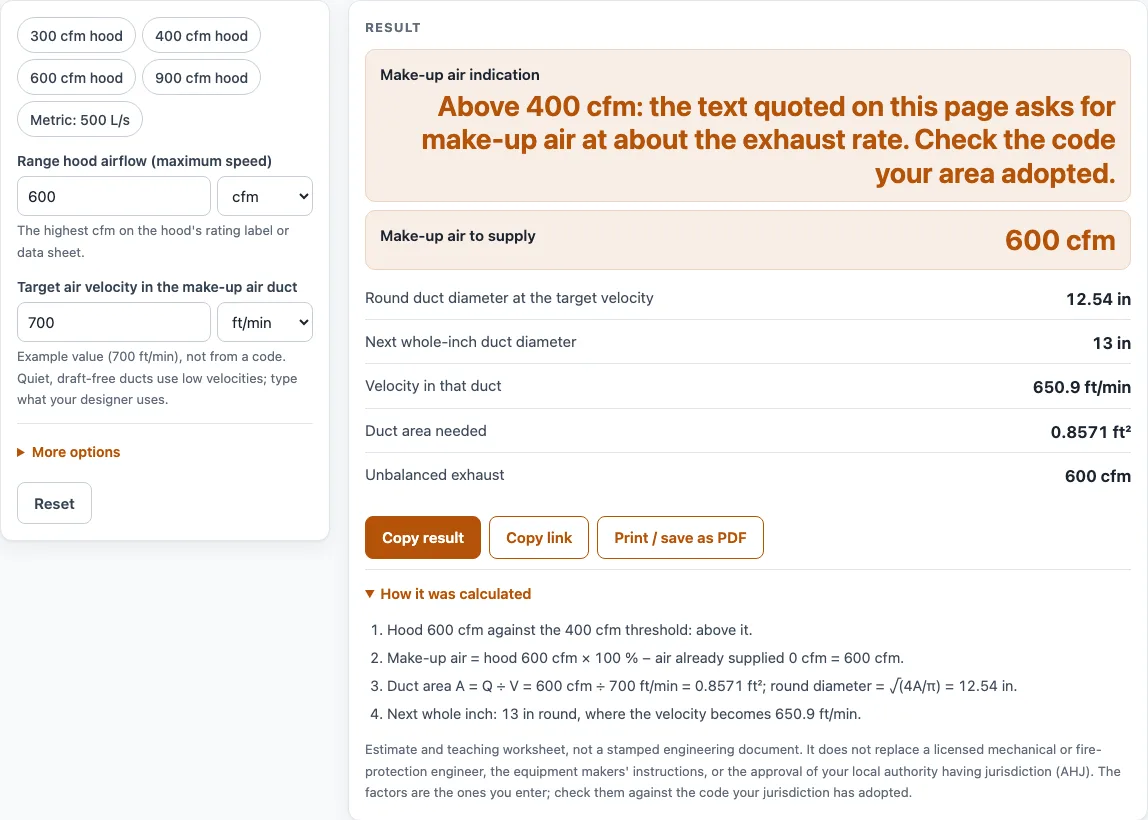
Duct sizing uses continuity. The duct area equals airflow divided by velocity, so A = Q ÷ V. For a round duct, the diameter is D = √(4A ÷ π). For example, 600 cfm at 700 ft/min needs 0.857 ft², which gives 12.54 in. The next whole inch is 13 in., and at that size the velocity is 650.9 ft/min. A metric example works the same way: a 500 L/s hood with a 4 m/s target needs 0.125 m² of duct, or 15.7 in. (399 mm), so a 16 in. round duct at 759 ft/min.
When can a hood create a pressure difference?
If you type an opening or leakage area, the page estimates the pressure across it with ΔP = (Q ÷ (2610 × A))² in. w.g., then converts the result to pascals. The constant 2610 is secondhand. The Penn State opening table implies about 2,450, so the two values differ. The page uses 2610 and labels it in the step text. The brief says pressures of 3 Pa or greater create a risk of backdrafting fireplaces and certain combustion appliances, and that the difference should be kept below 3 Pa. That is why the page warns at 3 Pa or more. For example, 900 cfm at 800 ft/min with a 0.5 ft² opening gives 15 in. round duct at 733 ft/min and 118.5 Pa across the opening, so the warning shows.
Worked examples
| Input | Result |
|---|---|
| hood 600 cfm, duct velocity 700 ft/min | make-up air 600 cfm, 13 in round duct |
| hood 300 cfm, duct velocity 700 ft/min | make-up air 300 cfm, 9 in round duct |
| hood 900 cfm, duct velocity 800 ft/min | make-up air 900 cfm, 15 in round duct |
| hood 500 L/s, duct velocity 4 m/s | make-up air 500 L/s, 16 in round duct |
Calculated by the tool above; open it with the same values to see each step.
Frequently asked questions
Does this tool judge my kitchen against a code?
No. The tool calculates values from the numbers you enter and shows what the named source says. It does not check your design against any code.
Why do the sources give different section numbers?
The Penn State brief cites M1503.4 of the 2009 IRC, and a South Carolina text seen in a search summary cites M1503.6 for the same provision. The section number depends on the edition, so check the code your jurisdiction has adopted.
Where does the 700 ft/min figure come from?
It is an example default for the target duct velocity. It is not a code figure, so replace it with the value your design or your cited text uses.
Does the page cover commercial hoods?
No. The page covers home kitchens only and does not cover commercial hoods. The Penn State brief’s comments on systems above 400 cfm refer to commercial-type systems, so get an HVAC expert involved for those.
Why does the warning appear at 3 Pa?
The Penn State brief says pressures of 3 Pa or greater create a risk of backdrafting fireplaces and certain combustion appliances, and that the difference should be kept below 3 Pa. The page shows the warning at that level.
Is anything I type uploaded?
No. Everything runs in your browser. Nothing is uploaded, and no sign-up is needed.
Related tools
- Air Changes per Hour Calculator: use it to compare room air change rates when you are checking ventilation in a space.
- Kitchen Exhaust Fan Size Calculator: use it when you are choosing an exhaust fan size for a kitchen.
- Heated Make Up Air Unit Calculator: use it when the supplied make-up air needs heating.
- Make Up Air Unit for Kitchen Hood: use it when you are looking at a make-up air unit for a kitchen hood.
- Range Hood CFM Calculator: use it to estimate the airflow a range hood needs before you size make-up air.
- Make-Up Air, Air Changes and Kitchen Exhaust: browse the whole group of replacement air and exhaust worksheets.
- Duct Velocity Calculator: use it to relate airflow to duct size and velocity.
- Static Pressure Calculator: use it to add up duct friction and fitting losses.