Hood and Duct Cleaning Schedule
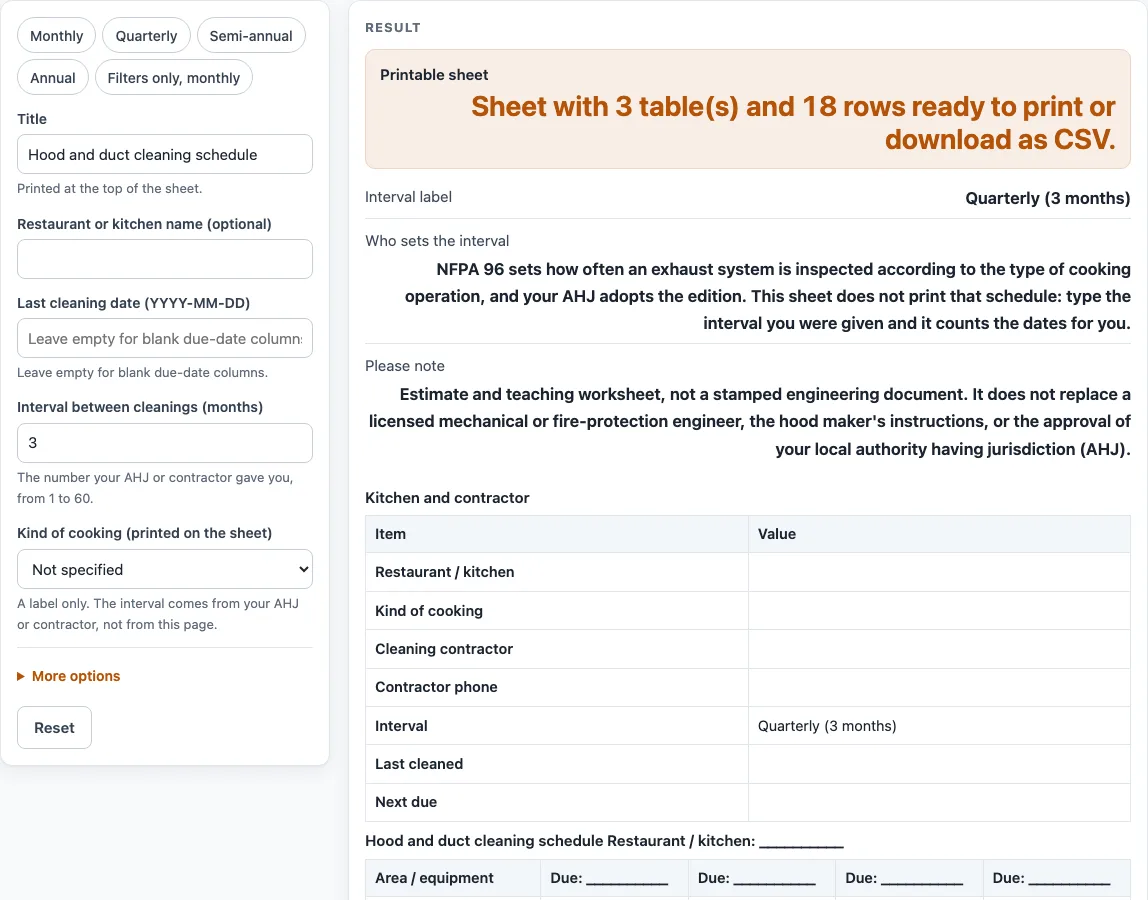
Type the last cleaning date and the interval you were given; the sheet counts the due dates and prints check boxes and a service record.
Recent
Your last 10 settings, saved only in this browser. Nothing is uploaded.
How to use the Hood and duct cleaning schedule
- Type a name in “Title”, or keep the default “Hood and duct cleaning schedule”.
- Optionally type your “Restaurant or kitchen name”.
- Type the “Last cleaning date (YYYY-MM-DD)”, for example 2026-08-31. Leave it empty if you only want a blank sheet.
- In “Interval between cleanings (months)”, type the whole number of months you were given, from 1 to 60. The default is 3.
- Choose a “Kind of cooking (printed on the sheet)” option. It appears on the sheet as a label only.
- Open “More options”. Enter the “Cleaning contractor” if you have one. Set “Due-date columns” (1 to 6, default 4) and “Service record rows” (1 to 40, default 6).
- Switch area rows on or off: Hood, Grease filters or baffles, Grease duct, Exhaust fan, Rooftop grease containment (all on by default) and Access panels (off by default). At least one area row must stay on.
- Check “Next due date” and “Due dates on the sheet” in the outputs.
- Click Print to print the sheet, or Download as CSV to save the table data.
The presets (Monthly, Quarterly, Semi-annual, Annual and Filters only, monthly) fill in an interval and column count for you. You can change any value after applying one, and the printed sheet updates at once.
How are the due dates on a hood and duct cleaning schedule worked out?
Due dates are calendar arithmetic only. Due date k equals the last cleaning date plus k times the interval in months, counted from the date you typed, not chained from the previous due date. The calculation is month-end safe. For example, 31 Aug 2026 plus 6 months is 28 Feb 2027, plus 12 months is 31 Aug 2027, and plus 18 months is 29 Feb 2028, because 2028 is a leap year. A monthly interval from 31 Jan 2027 gives 28 Feb, 31 Mar, 30 Apr and 31 May 2027.
Who sets the interval for hood and duct cleaning?
The authority having jurisdiction (AHJ) adopts the edition of NFPA 96 that applies, and the edition sets inspection frequency by type of cooking operation. The page does not set an interval and does not print an NFPA 96 interval table. You type the interval you were given. A village fire-inspector information sheet from Village of New Paltz, NY, summarises NFPA 96-2017 and says the exhaust system is inspected for grease buildup by a properly trained and qualified company or person acceptable to the AHJ, at a frequency that depends on the kind of cooking operation. Other sources found while building this tool disagreed on which category gets which interval, so no interval is attached to “Kind of cooking”. Check the edition your AHJ has adopted.
What should a hood and duct cleaning record include?
The same village sheet says a certificate with the name of the servicing company, the name of the person doing the work and the date is kept on the premises. It also says a sticker on the hood shows the next inspection or cleaning date. The Service record table follows those points with Company, Technician, Date, “Label placed” and “Next due” columns, so you can keep the same details in one place.
What does this page leave out?
The page does not describe how to clean a hood or duct, and it says nothing about grease fires. A licensed fire-protection contractor and the AHJ decide what applies to your kitchen. The sheet records the dates and names you enter, and the due dates are plain calendar arithmetic on the numbers you type. If the interval you were given changes, for example after a new inspection or a change of cooking, edit the number and print a fresh sheet. It does not check an installation or a service visit against any rule.
Worked examples
| Input | Result |
|---|---|
| Interval 3 months, last cleaning — | Blank due-date columns |
| Interval 6 months, last cleaning 2026-08-31 | First due date 2027-02-28 |
| Interval 1 months, last cleaning 2027-01-31 | First due date 2027-02-28 |
| Interval 12 months, last cleaning — | Blank due-date columns |
Calculated by the tool above; open it with the same values to see each step.
Frequently asked questions
How often does hood and duct cleaning need to happen?
The AHJ and the edition of NFPA 96 they have adopted set the frequency, based on the kind of cooking operation. Type the interval you were given into “Interval between cleanings (months)”. The tool does not choose one for you.
Can I use the Monthly preset for my kitchen?
The presets only fill in an interval number and a column count, and each interval label (Monthly, Quarterly and so on) is just a name for that number. They are not statements about what your kitchen needs. Ask your AHJ before you rely on any interval.
What happens if I leave the last cleaning date empty?
The columns read “Due: __________” with no date, and the “Next due date” output does not appear. The sheet still prints, so you can fill in dates by hand.
Does the tool save what I type?
Nothing is stored or uploaded. Everything runs in your browser, and the tool is free with no sign-up.
Why did a number I typed change to a smaller value?
Due-date columns above 6, interval above 60 and service record rows above 40 are capped, and a warning shows. Values below 1 cause an error.
Is the printed sheet a stamped engineering document?
No. It is an estimate and teaching worksheet, not a stamped engineering document. It does not replace a licensed engineer, the hood maker’s instructions or your AHJ.
Related tools
- NFPA 96: What It Covers and Where to Look: use it to find which NFPA 96 chapter titles cover a topic.
- Restaurant Hood Requirements Checklist: use it to print questions to take to your AHJ, designer, supplier or insurer.
- Commercial Kitchen Ventilation Worksheet: use it to gather hood, air balance, duct and fan numbers on one sheet.
- Codes, Cleaning and Checklists: use it to see all the code, cleaning and checklist pages together.
- Type 1 Hood: use it to read which appliances are usually asked about for a Type 1 hood.
- Grease Duct Velocity Calculator: use it to calculate duct velocity from airflow and duct size.
- Commercial Kitchen Exhaust Fan Calculator: use it to estimate fan horsepower and kW.