Grease Duct Velocity Calculator
Enter the exhaust airflow and the duct size to see the velocity, or type the minimum and maximum velocity your source gives to see the duct sizes between them.
Recent
Your last 10 settings, saved only in this browser. Nothing is uploaded.
How to use the Grease Duct Velocity Calculator
- In “What do you want to find?”, choose velocity from airflow and size, airflow from velocity and size, duct size from a target velocity, or the duct size range between two limits you type.
- Pick the units for duct size (in, mm, cm, ft or m) and airflow (cfm, L/s or m³/h). The airflow unit sets the output: cfm gives ft/min and in. w.g.; L/s or m³/h gives m/s and Pa.
- Enter the airflow (Q).
- Choose Round or Rectangular. For round, enter the diameter. For rectangular, enter the width and height. If you enter one side and need the other, set the aspect ratio (default 2).
- Enter the duct size or the target velocity, depending on the mode.
- Optional: open “More options” for air temperature and elevation. At 70 F and sea level the density factor is 1.000.
- Optional: type “Your minimum velocity” and “Your maximum velocity” from your own design guide, the hood maker’s listing or your authority having jurisdiction (AHJ). The page then prints one neutral sentence, such as “within the range you typed.”
- Read the result table and any warnings. Velocity above 6,000 ft/min or below 100 ft/min, or an aspect ratio above 8:1, means you should check your inputs.
The presets load worked examples, such as 3,000 cfm in a 16 in round duct or 1,500 L/s through a 400 mm round duct. Friction loss is not included. Use the Static Pressure Calculator for that.
How do airflow, duct size and velocity relate in a grease duct?
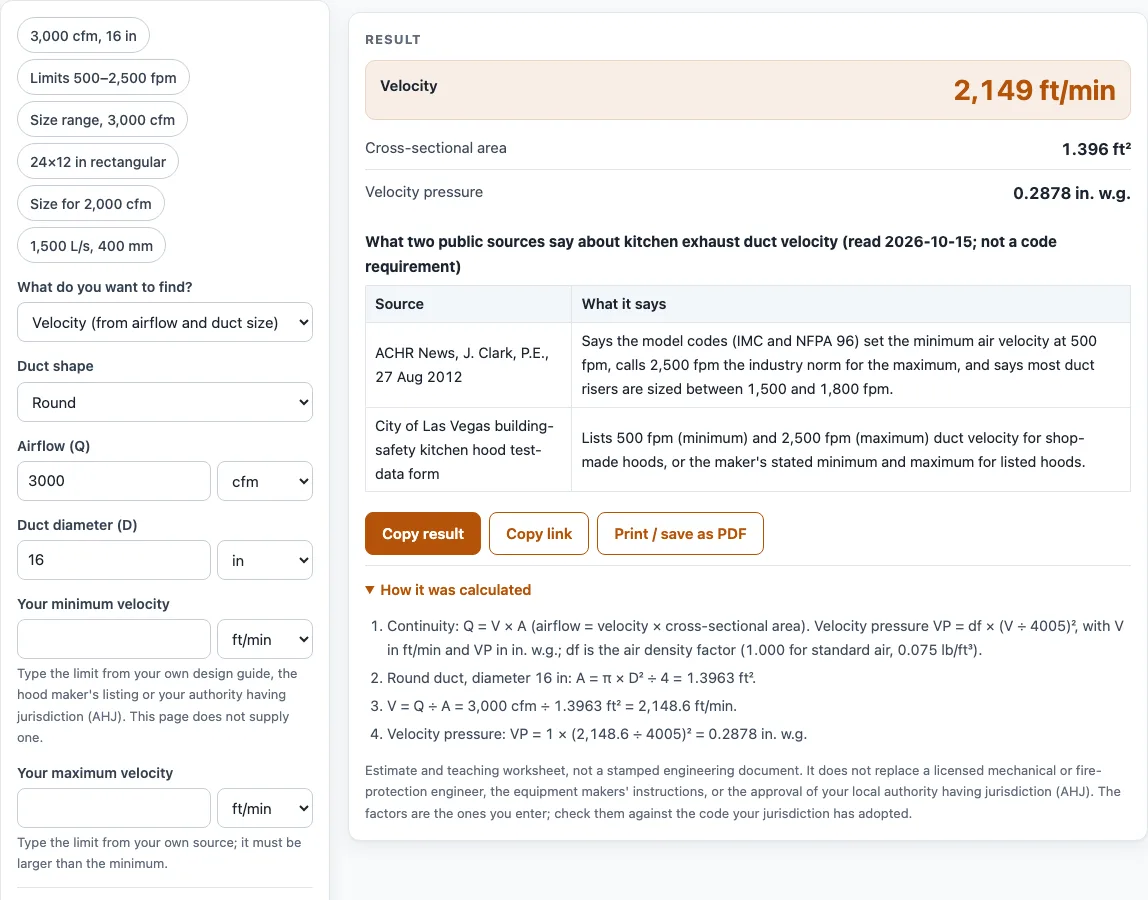
Airflow, duct size and velocity are tied together by continuity: Q = V × A, where Q is airflow, V is air velocity and A is the cross-sectional area of the duct. Rearranged, V = Q ÷ A and A = Q ÷ V. If you know two values, you can find the third. For example, 3,000 cfm through a 16 in round duct has an area of 1.396 ft² and a velocity of about 2,149 ft/min.
How is the area of a round or rectangular grease duct found?
For a round duct, the area is A = π × D² ÷ 4, where D is the diameter. For a rectangular duct, the area is width × height. The page converts your entry to ft² before it runs the continuity formula. For example, a 24 × 12 in rectangle has an area of 2 ft², so 3,000 cfm gives 1,500 ft/min. The same page also shows the equal-area round diameter (19.15 in for that example) and the hydraulic diameter (16 in). Rectangles with an aspect ratio above 8:1 trigger a warning.
What does velocity pressure mean in this calculation?
Velocity pressure is VP = df × (V ÷ 4005)², in in. w.g., with V in ft/min. The 4005 constant applies to standard air at 0.075 lb/ft³. The density factor df is 1.000 at 70 F and sea level, and you can change it under “More options.” At 2,149 ft/min, the example above gives a velocity pressure of 0.2878 in. w.g. This is an estimate from the values entered. A fan maker’s page, seen in a search excerpt, gives 4004.4 for exactly 0.075 lb/ft³, so small differences between tools are expected.
Why do velocity limits for a grease duct differ between sources?
The sources in this page’s table do not agree. ACHR News (J. Clark, P.E., 2012-08-27) says the IMC and NFPA 96 set a minimum of 500 fpm, calls 2,500 fpm the industry norm for the maximum, and says most risers are sized at 1,500 to 1,800 fpm. A city of Las Vegas hood test-data form lists 500 fpm minimum and 2,500 fpm maximum for shop-made hoods, or the maker’s stated range for listed hoods. The edition of the IMC or NFPA 96 adopted by your jurisdiction decides which rule applies. The 500 fpm figure was read in those public pages, not in the standard text. The limits you type are compared only to the page’s calculation. They do not make a duct acceptable.
Worked examples
| Input | Result |
|---|---|
| 3000 cfm, 16 in | 2,149 ft/min, velocity pressure 0.288 in. w.g. |
| 3000 cfm, 16 in | 2,149 ft/min, velocity pressure 0.288 in. w.g. |
| 3000 cfm, 500-2500 ft/min | round 14.83 in to 33.17 in |
| 2000 cfm, 1500 ft/min | round 15.64 in, area 1.333 ft² |
| 3000 cfm, 24 x 12 in | 1,500 ft/min, velocity pressure 0.14 in. w.g. |
| 1500 L/s, 400 mm | 11.94 m/s, velocity pressure 85.7 Pa |
Calculated by the tool above; open it with the same values to see each step.
Frequently asked questions
Does this tool say whether my grease duct is acceptable?
No. It calculates velocity, area and velocity pressure from the values you enter. It is an estimate and teaching worksheet, not a stamped engineering document, and it does not replace a licensed engineer, the hood maker’s instructions or your authority having jurisdiction (AHJ).
Where should the minimum and maximum velocities come from?
Use values from your own design guide, the hood maker’s listing or your AHJ. Public sources differ, as shown in the table under the result, so check which edition of the code your jurisdiction has adopted.
What does the duct size range mode show?
You type a minimum and a maximum velocity, and the page shows the largest and smallest area between them. For example, 3,000 cfm with 500 and 2,500 ft/min typed gives 6 ft² (round 33.17 in) at the minimum velocity and 1.2 ft² (round 14.83 in) at the maximum. Those two numbers are examples you typed, not limits from a code.
Why does the output change between cfm and L/s?
The airflow unit sets the output units. cfm gives ft/min and in. w.g., while L/s or m³/h gives m/s and Pa. The calculation is the same; only the units change.
Why does the page show a warning?
It flags velocity above 6,000 ft/min or below 100 ft/min, and an aspect ratio above 8:1. Treat a warning as a prompt to check the values you typed.
Does the calculator include friction loss or fan selection?
No. Friction loss is not included. For that, use the Static Pressure Calculator, and for fan sizing, see the Commercial Kitchen Exhaust Fan Calculator.
Is my data uploaded anywhere?
No. The calculator runs in your browser, nothing is uploaded, and no sign-up is needed. It is free to use.
Related tools
- Ducts, Fans and Static Pressure: the hub for the duct, fan and pressure worksheets on this site.
- Duct Velocity Calculator: velocity, area and velocity pressure for any round or rectangular duct.
- Static Pressure Calculator: friction and fitting losses, which this page does not include.
- Commercial Kitchen Exhaust Fan Calculator: brake horsepower, motor kW and yearly energy from cfm and pressure.
- Type 1 Hood: the Type I (grease) hood appliance selector and exhaust cfm worksheet.
- NFPA 96: What It Covers and Where to Look: a topic finder with questions to take to your AHJ.
- Hood and Duct Cleaning Schedule: a printable schedule with due dates and a service record.
- Commercial Kitchen Ventilation Worksheet: a printable worksheet with air balance and fan hp.