Exhaust Hood Calculator
Type the opening width and height and a face velocity to get the airflow in cfm and L/s, or turn it around to find the velocity or the opening.
Recent
Your last 10 settings, saved only in this browser. Nothing is uploaded.
How to use the Exhaust Hood Calculator
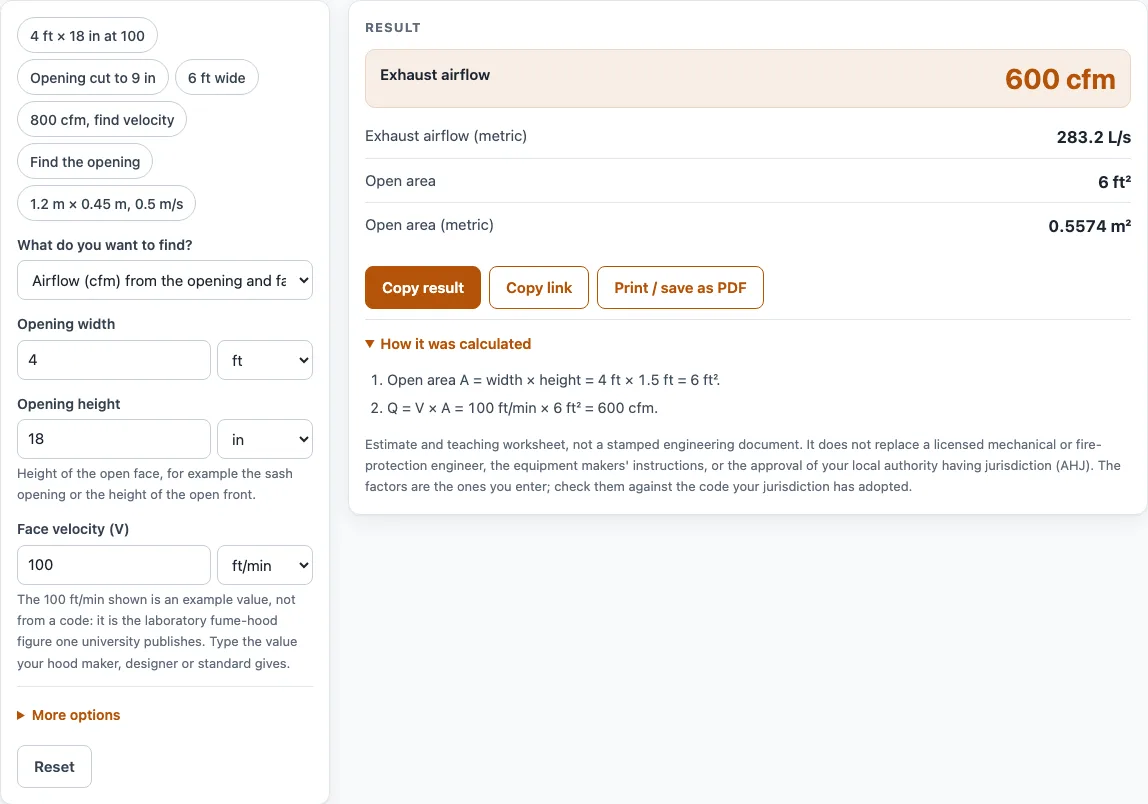
- Under “What do you want to find?”, choose “Airflow (cfm) from the opening and face velocity”, “Face velocity from the airflow and the opening”, or “Opening height from the airflow, velocity and width”.
- For airflow mode, type the opening width and the opening height. Pick ft, in, m or mm for each length.
- Type the “Face velocity (V)” in ft/min or m/s. Use the value your hood maker, designer or standard gives. The 100 ft/min in the default is only a worked example.
- Read the airflow in cfm and L/s, and the open area in ft2 and m2.
- For face velocity mode, enter the “Exhaust airflow (Q)” in cfm, L/s or m3/h, along with the opening. The result shows the face velocity in ft/min and m/s.
- For opening height mode, enter the airflow, the face velocity and the width. The result shows the height the opening needs.
- Optional: type your minimum and/or maximum face velocity in ft/min. The “Against your limits” result then says whether your result is below, within or above those limits. The limits are the ones you type, and the page does not judge the hood against them.
- Watch for the warning that appears when the velocity is under 50 ft/min.
Each field accepts its own unit, so you can type a width in mm and a face velocity in m/s. You do not need to convert values before you enter them, because the results show both unit systems.
What is the open-face method behind an exhaust hood calculator?
The open-face method assumes that all the air pulled into a hood passes through its open front at a fairly even speed. The airflow is the face velocity multiplied by the open area, which is the continuity relationship Q = V x A. The open area is the width multiplied by the height of the opening, so both dimensions must be in compatible units before you multiply them.
A worked example uses a 4 ft wide opening at 18 in high. That is 4 ft x 1.5 ft, or 6 ft2. At 100 ft/min, the airflow is 600 cfm, which is 283.2 L/s. Cutting the opening height to 9 in halves the area and the airflow to 300 cfm. A 6 ft wide opening at 18 in gives 900 cfm.
The same formula runs in reverse. If 800 cfm passes through the 6 ft2 opening, the face velocity is 133.3 ft/min, or 0.6773 m/s. For opening height mode, 600 cfm at 100 ft/min needs 6 ft2 of area. Across a 4 ft width, that is 18 in high.
Metric values work the same way. A 1.2 m x 0.45 m opening has an area of 0.54 m2. At 0.5 m/s, the airflow is 0.27 m3/s, or 270 L/s, which is 572.1 cfm. A face velocity of 0.5 m/s equals 98.43 ft/min.
How do you choose a face velocity for a hood?
Face velocity and capture velocity are not the same thing. Capture velocity is the air speed needed at the point where the contaminant is released, so that it is pulled into the hood. Face velocity is measured at the hood opening. The sources in this group quote capture velocities of 50 to 100 ft/min for the CIH guide and 75 to 175 ft/min for canopy hoods in a Penn State table. The 50 ft/min warning on this page matches the lowest capture velocity in the public sources used.
The sources also disagree. The Oregon State page quotes 100 ft/min at 18 in. Other university pages, seen only as search-result snippets and not opened, quote 80 to 120 ft/min or 100 +/- 20 ft/min. The 100 ft/min in the default is one of these figures, and it is used only as an example. A kitchen or process hood needs the value its maker, designer or the applicable standard gives. Kitchen hoods are also rated through listing tests rather than by face velocity alone.
The worksheet covers open-face hoods only. Slot hoods, plenums, baffles, flanges and entry losses are outside its scope. It also does not tell you whether a hood contains its contaminant.
Results are calculated from the values and factors you enter. This is not a stamped engineering document, and it does not replace a licensed engineer, the hood maker’s instructions or the authority having jurisdiction (AHJ).
Worked examples
| Input | Result |
|---|---|
| 4 ft wide opening, 100 ft/min | 600 cfm (283.2 L/s) |
| 4 ft wide opening, 100 ft/min | 300 cfm (141.6 L/s) |
| 800 cfm through a 4 ft wide opening | 133.3 ft/min |
| 600 cfm at 100 ft/min, 4 ft wide | opening 18 in high |
| 3.937 ft wide opening, 98.43 ft/min | 572.1 cfm (270 L/s) |
Calculated by the tool above; open it with the same values to see each step.
Frequently asked questions
Does this exhaust hood calculator approve my kitchen hood?
No. The results are calculated from the values you enter. The page does not say whether a hood is approved, listed or acceptable. Check your design with a licensed engineer, the hood maker’s instructions and the AHJ.
Where does the 100 ft/min value come from?
It is an example figure from a laboratory fume-hood guideline published by one university, and it is used only as a worked example. It is not from a code. Use the face velocity your hood maker, designer or standard gives.
What does the warning under 50 ft/min mean?
The warning appears when the face velocity is under 50 ft/min. That is the lowest capture velocity in the public sources used. It is a prompt to check your figures, not a verdict on the hood.
Can I use this tool for slot hoods or hoods with plenums?
No. The worksheet handles open-face hoods only. Slot hoods, plenums, baffles, flanges and entry losses are outside its scope.
What are the minimum and maximum limits for?
They are optional. Type a minimum and/or maximum face velocity in ft/min, and the page will say whether your result is below, within or above them. The limits are the ones you type, not limits that the page sets.
Can I enter measurements in metric units?
Yes. Width and height can be typed in m or mm, face velocity in m/s, and airflow in L/s or m3/h. Results show both unit systems.
Related tools
- Kitchen Hood CFM Calculator: use it when you want an airflow estimate for a commercial kitchen hood.
- Commercial Kitchen Hood Sizing Worksheet: use it when you are working through the sizing steps for a commercial kitchen hood.
- Type 1 Hood: read it to learn about Type 1 hoods for grease-producing equipment.
- Type 1 vs Type 2 Hood: read it to compare the two hood types side by side.
- Type 2 Hood: read it to learn about Type 2 hoods for heat and steam without grease.
- Ventless Hood Guide: read it to understand ventless hood options and how they differ from ducted hoods.
- Commercial Kitchen Hoods: the hub page for all hood tools and guides.
- Commercial Kitchen Exhaust Fan Calculator: use it to look at the exhaust fan side of a kitchen worksheet.
- Make Up Air Unit for Kitchen Hood: use it to compare make-up air with an exhaust total.