Ducted vs Ductless Range Hood
Say whether you can run a duct, what you cook on and how you cook to see which range hood type fits, and compare the two side by side.
Recent
Your last 10 settings, saved only in this browser. Nothing is uploaded.
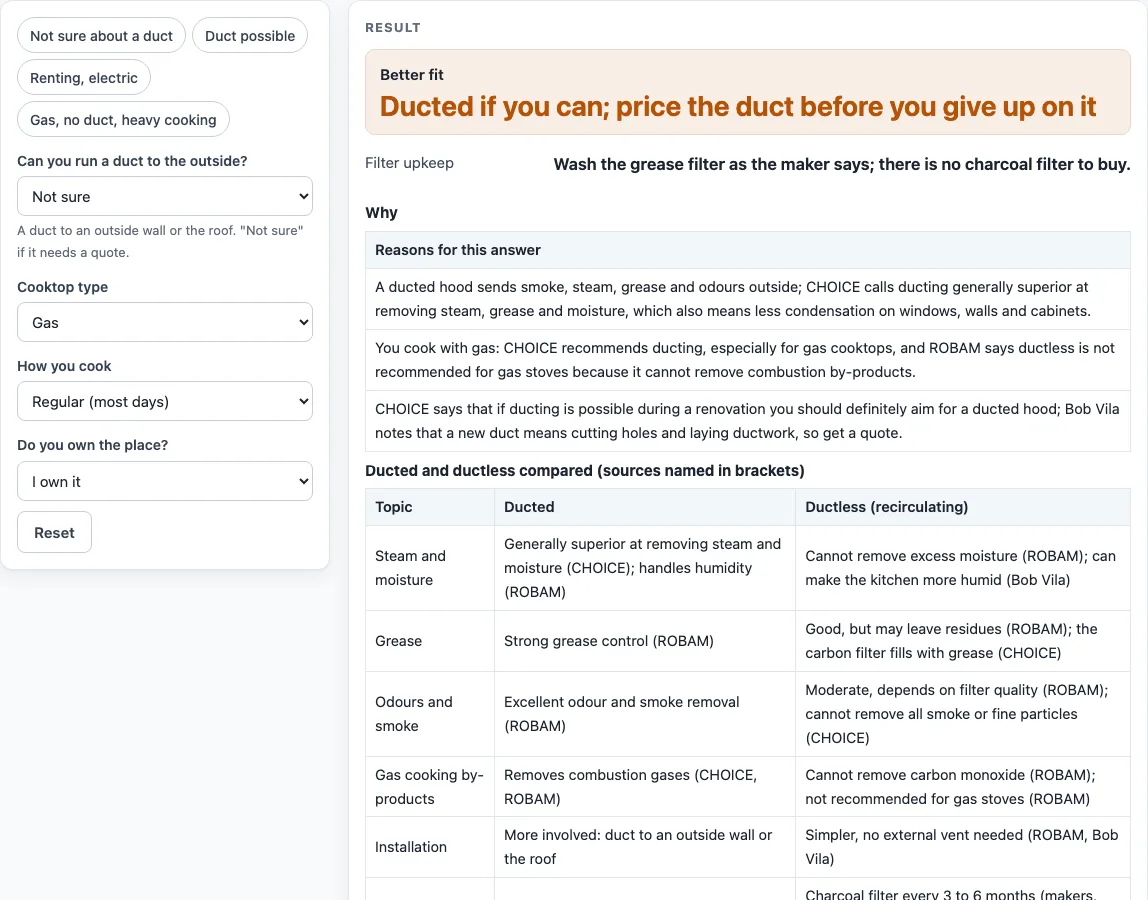
How to use the Ducted vs Ductless Range Hood chooser
- Answer “Can you run a duct to the outside?” with “Yes, a duct is possible”, “Not sure”, or “No, there is no way to vent outside”.
- Pick your “Cooktop type”: “Gas”, “Electric”, or “Induction”.
- Pick “How you cook”: “Light (a few meals a week)”, “Regular (most days)”, or “Heavy (frying, searing, grilling)”.
- Answer “Do you own the place?” with “I own it” or “I rent it”.
- Read the two result lines, “Better fit” and “Filter upkeep”.
- Check the “Why” table and the “Ducted and ductless compared” table. Warnings appear for a gas cooktop, heavy cooking, or humidity with a ductless hood, so read those too.
If you want to see how the chooser handles common cases, use the example buttons, which fill in all four answers at once: “Not sure about a duct”, “Duct possible”, “Renting, electric”, and “Gas, no duct, heavy cooking”.
Under the result, “Copy result” copies the answer. “Copy link” copies the page address, which keeps all your inputs, so opening it restores the same result. “Print / save as PDF” prints your inputs, the result, the calculation steps, and the date. The “How it was calculated” list shows each step using your own values.
What is the difference between ducted and ductless range hoods?
A ducted range hood pulls air from above the stove and vents it outside through ductwork. A ductless range hood, also called a recirculating hood, filters the air and sends it back into the kitchen. ROBAM Living notes that ducted hoods handle heat, humidity and combustion by-products because they exhaust air outdoors, while ductless hoods cannot remove carbon monoxide or excess moisture.
CHOICE says ducting vents smoke, steam, grease, odours and other contaminants outside, and that it is generally better at removing steam, grease and moisture. That reduces condensation on windows, walls and cabinets. Bob Vila adds that a ductless install is simpler, about an hour for a DIY job, while a ducted install needs holes cut and ductwork laid.
The chooser applies three simple rules drawn from these sources. If a duct is possible, it suggests a ducted hood. If you are not sure, it suggests a ducted hood when you can price the duct, unless you rent, in which case it suggests a ductless hood. If there is no way to vent outside, it suggests a ductless hood.
Do ductless range hoods work?
Yes, they remove some grease, odour and smoke, but they do not remove everything. CHOICE says recirculating hoods cannot clean or remove all smoke or fine particles. ROBAM rates their odour and smoke removal as moderate and says it depends on filter quality, and Bob Vila notes that ductless models can make a kitchen more humid.
Performance depends heavily on the filters. CHOICE says carbon filters lose effectiveness as they become saturated with grease, and that frying, searing or grilling can overwhelm them. According to Bob Vila, ductless hoods suit limited space, no existing ductwork, no exterior walls, renting, or a tighter budget. ROBAM calls them “ideal for apartments or homes where external venting isn’t an option.”
How often should you change the charcoal filter in a ductless range hood?
CHOICE says manufacturers generally recommend replacing charcoal filters every three to six months. ROBAM suggests every 3 months for daily high-heat or strongly spiced cooking, and about every 6 months for lighter use. Bob Vila says ductless filters need cleaning or replacement at least every 6 months, and that frequent cooks should wash the grease filter monthly.
Filters are a running cost. CHOICE estimates that running a recirculating hood efficiently costs $39 to $476 a year, depending on cooking habits, and that filters can cost up to over $400 a year. Filters are often brand-specific and can be hard to source for older models, so check your model before you buy.
Sources (checked 18 October 2026): choice.com.au · robamliving.com · bobvila.com
Worked examples
| Input | Result |
|---|---|
| Not sure, Gas, Regular (most days) | Ducted if you can; price the duct before you give up on it |
| Yes, a duct is possible, Gas, Regular (most days) | Ducted (vented outside) |
| No, there is no way to vent outside, Electric, Light (a few meals a week) | Ductless (recirculating) is the practical choice |
| No, there is no way to vent outside, Gas, Heavy (frying, searing, grilling) | Ductless (recirculating) is the practical choice |
Calculated by the tool above; open it with the same values to see each step.
Frequently asked questions
Can I use a ductless range hood with a gas cooktop?
ROBAM says ductless hoods are not recommended for gas stoves, and that building codes in many areas call for ducted ventilation for gas appliances. CHOICE recommends ducting, especially for gas cooktops. The chooser shows a warning for this combination, but it does not know your local code, so check with a qualified installer or your local authority.
Is a ducted range hood a better choice if I cook often?
CHOICE recommends ducting for people who cook often, and Bob Vila says a ducted hood is best if you cook often or want stronger humidity and odour removal. In the chooser, how you cook adds warnings and sets the filter advice; the ducted or ductless answer comes from whether you can duct and whether you rent.
Does this chooser tell me the right hood height or CFM?
No. The chooser does not cover hood height or CFM. Use the range hood height and CFM tools on this site for those numbers.
Does the chooser know my local building code or my specific hood?
No. It applies simple rules from the named sources and does not know your local code or the specific hood you plan to buy. Your hood’s installation manual and your local codes decide what is suitable for your kitchen.
Related tools
- Range Hood Height Above Stove — how high the bottom of the hood goes above the cooktop
- Range Hood CFM Calculator — target airflow and duct loss for a range hood
- Make-Up Air for Range Hood — plan the air that replaces what the hood exhausts
- Ventless Hood Guide — ventless hoods in commercial kitchens rather than homes
- Kitchen Exhaust Fan Size Calculator — estimate the exhaust fan size for a kitchen
- Make-Up Air and Kitchen Exhaust — every make-up air and kitchen exhaust tool on this site