Commercial Kitchen Ventilation Worksheet
Type your hoods, appliances and air quantities; the sheet works out face velocity, air balance, duct velocity and fan horsepower and prints with sign-off lines.
Recent
Your last 10 settings, saved only in this browser. Nothing is uploaded.
How to use the Commercial Kitchen Ventilation Worksheet
- Type a “Project name” (optional). Under “More options” you can also add “Title”, “Address” and “Prepared by”.
- In “Hoods”, enter one line per hood (up to 6): name; length (ft); opening depth (ft); exhaust (cfm).
- In “Appliances”, enter one line per appliance: name; fuel; count; hood type; duty. Only the name is required, and count defaults to 1. The page lists them as typed (up to 12) and does not classify them.
- Enter “Other exhaust (cfm)” and “Other supply air (cfm)”.
- Enter “Make-up air supplied (cfm)” from your design.
- Enter “Round duct diameter (in.)” if you want the duct row.
- Enter “Fan total static pressure (in. w.g.)” and “Fan efficiency (%)”. Take both from the fan maker or the designer. Efficiency must be above 0 and at most 100.
- Read “Total exhaust”, “Make-up air needed”, “Imbalance”, “Duct velocity” and “Fan brake horsepower”.
- Under “More options”, set “Duct airflow (cfm)” or “Fan airflow (cfm)” if they differ from the hood total. Add “Notes” (one per line, up to 12), and switch the duct row, fan row or the prepared by / reviewed by lines on or off.
- Check the “Please note” text, then choose Print or Download as CSV to get the “Printable sheet”.
Five presets are available. “Example: small restaurant” loads the default values, and “Blank sheet” clears all rows and turns off the duct and fan rows.
How do you calculate face velocity for a hood?
Face velocity is the airflow through the hood opening divided by the opening’s area. The page uses face area (ft²) = length × opening depth, and face velocity (fpm) = cfm ÷ face area, which follows the continuity relation Q = V × A.
For the default Hood 1, a 10 ft by 3 ft opening gives 30 ft². At 3000 cfm, the face velocity is 100 fpm. Hood 2 is 4 ft by 3 ft, or 12 ft², and at 800 cfm it gives 66.7 fpm. The total area is 42 ft². These are example numbers, not values from a code.
What is the air balance in commercial kitchen ventilation?
The air balance compares the air leaving the kitchen with the air coming in. Total exhaust equals hood exhaust plus other exhaust. Make-up air needed equals total exhaust minus other supply air. Imbalance equals total exhaust minus the sum of other supply air and make-up air supplied, and the page also shows it as a share of total exhaust.
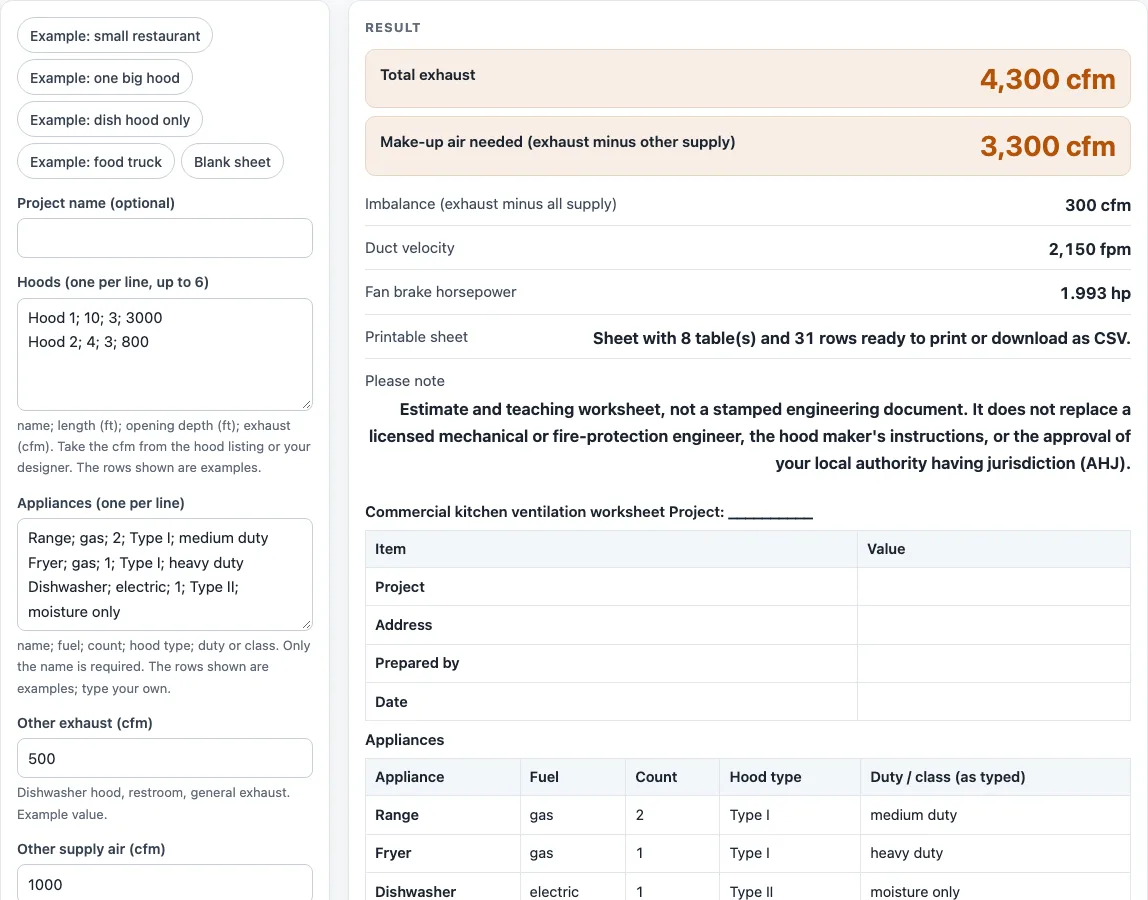
A positive imbalance means more air leaves than is supplied. With the defaults, total exhaust is 3800 + 500 = 4300 cfm, make-up air needed is 4300 − 1000 = 3300 cfm, and the imbalance is 4300 − (1000 + 3000) = 300 cfm, or 6.98 %. This bookkeeping is the page’s own method and does not come from a code rule.
How do you find duct velocity in a round duct?
Duct velocity is the airflow divided by the duct’s cross-sectional area. For a round duct, the page uses area = π × D² / 4, with D in feet, so an inch diameter is divided by 12 first. Velocity (fpm) = cfm ÷ area (ft²).
Airflow defaults to the total hood exhaust unless you type a value in “Duct airflow (cfm)”. The default 3800 cfm in an 18 in. duct has an area of 1.767 ft², which gives 2150 fpm. The page prints this velocity and does not judge it against any limit.
How is fan brake horsepower calculated?
Brake horsepower is airflow times static pressure, divided by 6356 times the fan efficiency written as a fraction. The formula is BHP = cfm × static pressure (in. w.g.) ÷ (6356 × efficiency). The 6356 constant is the one given in the Engineering ToolBox and Engineers Edge summaries that the page relies on.
As a check, 30,000 cfm at 13 in. w.g. and 100 % efficiency gives 61.4 hp, matching the Engineering ToolBox example. The formula assumes standard air. Engineers Edge notes that the generic equation does not correct for temperature, density or the fan’s airflow characteristics, so ask the fan maker for your conditions. We could read the constant only through search summaries of those two pages, so check it against your own reference. The default fan row uses 3800 × 2 ÷ (6356 × 0.60) = 1.99 hp, and the 60 % efficiency is an example only.
Worked examples
| Input | Result |
|---|---|
| 2 hood(s), other exhaust 500 cfm | Total exhaust 4300 cfm, imbalance 300 cfm |
| 1 hood(s), other exhaust 0 cfm | Total exhaust 4200 cfm, imbalance 0 cfm |
| 1 hood(s), other exhaust 0 cfm | Total exhaust 1200 cfm, imbalance 0 cfm |
| 1 hood(s), other exhaust 0 cfm | Total exhaust 900 cfm, imbalance 0 cfm |
Calculated by the tool above; open it with the same values to see each step.
Frequently asked questions
Does the result mean my design is acceptable?
No. The page calculates results from the values and factors you enter. It does not check them against any code, and it is not a stamped engineering document. Have a licensed engineer review the design, and follow the hood maker’s instructions and the authority having jurisdiction (AHJ).
Are the default numbers from a code?
No. The defaults are examples only, and they are labelled as such in the help lines. They include the appliances, two hoods, 500 cfm other exhaust, 1000 cfm other supply air, 3000 cfm make-up air, an 18 in. duct, 2 in. w.g. static pressure and 60 % efficiency. Replace them with your project values.
Why does the imbalance show as 6.98 % instead of 7 %?
The page shows the exact share, 300 ÷ 4300 = 6.98 %, and rounds it for display. The share is simply the imbalance divided by total exhaust.
Does the page tell me whether my duct velocity is acceptable?
No. The page prints the duct velocity from the airflow and diameter you enter. It does not compare that velocity with any limit, so you need to check it against the design requirements that apply to your project.
What happens if other supply air is larger than total exhaust?
The make-up air need becomes negative, and the page shows a warning. A negative value means the other supply air already covers the exhaust in the calculation. Check the airflow entries and the “Other supply air (cfm)” value.
Does the page store or upload what I type?
No. The page runs in your browser. Nothing is stored or uploaded, and no sign-up is needed. Your sheet exists only on the page until you choose Print or Download as CSV.
Related tools
- NFPA 96: What It Covers and Where to Look: use it to find which NFPA 96 chapter titles cover a topic.
- Hood and Duct Cleaning Schedule: use it to plan cleaning dates and keep a service record.
- Restaurant Hood Requirements Checklist: use it to print questions to take to your AHJ, designer, supplier or insurer.
- Codes, Cleaning and Checklists: use it to see all the code, cleaning and checklist pages together.
- Commercial Kitchen Hood Sizing: use it to work out a canopy hood size and exhaust airflow worksheet.
- Make Up Air Unit for Kitchen Hood: use it to work through an air balance for make-up air.
- Grease Duct Velocity Calculator: use it to calculate duct velocity from airflow and duct size.
- Commercial Kitchen Exhaust Fan Calculator: use it to estimate fan horsepower and kW.