Commercial Kitchen Exhaust Fan Calculator
Enter the exhaust airflow and the static pressure, or add up the component losses, to see brake horsepower, motor kW and energy per year.
Recent
Your last 10 settings, saved only in this browser. Nothing is uploaded.
The Commercial Kitchen Exhaust Fan Calculator estimates the power a commercial kitchen exhaust fan needs. From the exhaust airflow and the total static pressure you enter, it gives the brake horsepower, the motor input power in kW and the energy the fan uses per year. It runs in your browser, is free, needs no sign-up, and uploads nothing.
It does not select a fan or read fan curves. Designers, operators, students and contractors can use it to see how airflow, pressure and efficiency change the power figure for commercial kitchen hood exhaust fans. Results are calculated from the values and factors you enter. This is an estimate and teaching worksheet, not a stamped engineering document, and it does not replace a licensed engineer, the hood maker’s instructions or the authority having jurisdiction (AHJ).
How to use the Commercial Kitchen Exhaust Fan Calculator
- Choose the airflow unit (cfm, L/s or m3/h) and type the exhaust airflow for the hood or hoods.
- Under “How do you know the static pressure?”, choose “I have the total” and type the “Total static pressure (SP)” in in. w.g. or Pa. The default of 1.5 in. w.g. is an example, not a code value. Or choose “Add up component losses” and add up to eight losses (hood, filters, duct, fittings, damper, discharge) in the rows provided, and leave unused rows blank.
- Type the fan efficiency from the maker’s fan curve. The 60% default is an example.
- Type the motor efficiency from the motor nameplate. The 90% default is an example.
- Open “More options” if the air is not at 70 F or the site is not at sea level. Enter the temperature and elevation to get the density factor and a standard-air equivalent pressure and horsepower.
- Enter hours per day (default 12) and days per year (default 365) to get energy per year.
- Type an electricity price per kWh if you want a yearly cost. The cost line appears only after you enter a price.
- Read the results. For the fan curve, use “Point to compare with the maker’s fan curve”, which gives the airflow and standard-air equivalent pressure to look up.
Hp and kW are always both shown. If a warning appears, check the value you typed before you use the result.
How is brake horsepower calculated for a commercial kitchen exhaust fan?
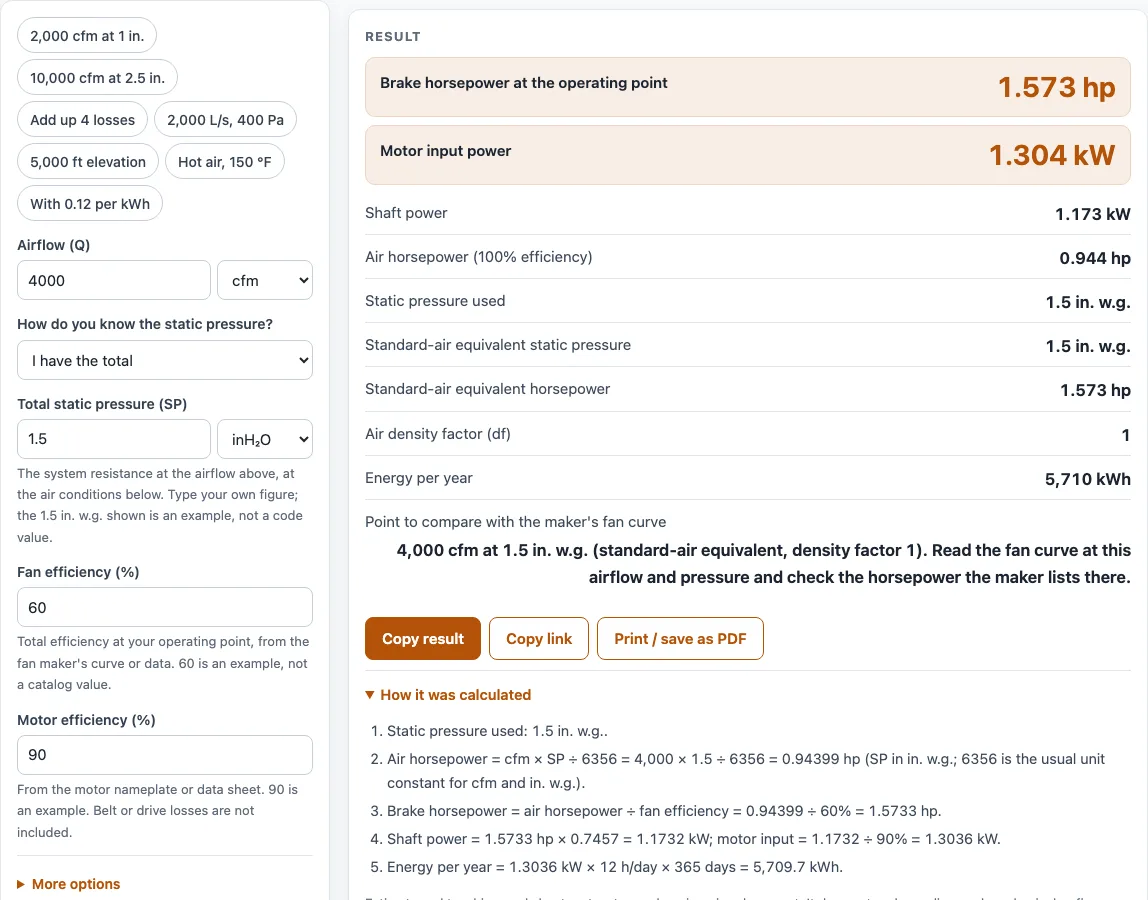
Brake horsepower depends on airflow, static pressure and fan efficiency. The formula is bhp = cfm x SP / (6356 x fan efficiency), with SP in in. w.g. In the default example, 4,000 cfm at 1.5 in. w.g. with 60% fan efficiency gives 1.573 bhp.
What is the difference between air hp, brake hp and motor kW?
Air hp is the power the air receives, so the default example gives 0.944 air hp. Shaft power in kW is bhp x 0.7457, which gives 1.173 kW in the same example. Motor input kW is shaft kW divided by motor efficiency, giving 1.304 kW at 90%. Belt or drive losses are not included.
How does the density factor change the result for hot or high sites?
The density factor is df = (530/(460+T F)) x pressure ratio, with the default at 70 F and sea level giving df 1.000. Standard air for fan catalogs is 0.075 lb/ft3 at 70 F, sea level, per the fan-industry bulletin FE-1600. Pressure and power scale with df, while airflow does not change. The page shows SP / df and bhp / df so you can read a catalog made for standard air.
For 3 in. at 350 F, df is 0.654 and the equivalent is 4.585 in. The bulletin rounds the factor to 1.53 and gets 4.59. HPAC’s fan series shows the factor only in a search excerpt, while the bulletin’s worked case agrees with 810/530 = 1.528 within rounding.
Why does the page use 6356 as the unit constant?
6356 is the usual unit constant for cfm and in. w.g. An SI check using 1 hp = 745.7 W gives 6343, which is 0.2% lower. The two sources differ, so results from this page may differ from a maker’s figures by that much. The page uses 6356.
How do component losses add up to total static pressure?
Total static pressure can be typed directly or summed from up to eight component losses. For example, 0.35 + 0.60 + 0.30 + 0.25 = 1.50 in. w.g. At 6,000 cfm with 60% fan efficiency and 90% motor efficiency, this gives 2.360 bhp and 1.955 kW input. The pressure typed is taken as the system resistance at the operating air.
How much energy does a commercial kitchen exhaust fan use per year?
Energy per year equals motor input kW x hours per day x days per year. The default example uses 1.304 kW x 12 h x 365 days, which gives about 5,710 kWh from the unrounded motor input. A cost appears only after you type a price per kWh, such as 0.12 per kWh.
Worked examples
| Input | Result |
|---|---|
| 4000 cfm, 1.5 in. w.g. | 1.573 bhp, motor input 1.304 kW |
| 2000 cfm, 1 in. w.g. | 0.5244 bhp, motor input 0.4345 kW |
| 6000 cfm, 1.5 in. w.g. | 2.36 bhp, motor input 1.955 kW |
| 2000 L/s, 400 Pa | 1.784 bhp, motor input 1.479 kW |
| 4000 cfm, 1.5 in. w.g. | 1.573 bhp, motor input 1.304 kW |
Calculated by the tool above; open it with the same values to see each step.
Frequently asked questions
Is the result a stamped engineering document?
No. The result is an estimate and teaching worksheet calculated from the values and factors you enter. It is not a stamped engineering document and does not replace a licensed engineer, the hood maker’s instructions or the authority having jurisdiction (AHJ).
Does this tool select a fan for me?
No. It gives brake horsepower, motor input kW and energy per year for the airflow and pressure you enter. It does not select a fan or read fan curves, so use the “point to compare” line to look up the maker’s published curve.
Why might my result differ slightly from a maker’s figure?
The page uses 6356 as the unit constant, while an SI check gives 6343, which is 0.2% lower. Results may differ by about that much. Typing the fan efficiency from the maker’s curve and the motor efficiency from the nameplate gives a closer comparison.
Can I use metric units?
Yes. Airflow can be typed in cfm, L/s or m3/h. With a metric flow unit the page shows pressure in Pa, and hp and kW are always both shown. For example, 2,000 L/s at 400 Pa and 20 C gives 1.784 bhp and 1.479 kW input.
Why does the page show a warning?
Warnings appear when static pressure is above 10 in. w.g., so check the unit. They also appear when the density factor is more than 5% from 1, where you should read the standard-air equivalent, or when fan efficiency is below 25%.
Does the calculator cover upblast or inline fans, or noise?
No. Upblast or inline fan types, noise and fan selection are outside what this page covers.
Related tools
- Ducts, Fans and Static Pressure: the hub for the duct, fan and pressure worksheets on this site.
- Static Pressure Calculator: add up duct friction and fitting losses to get a pressure figure to type here.
- Duct Velocity Calculator: check air speed in a duct run.
- Grease Duct Velocity Calculator: velocity in a grease duct, with limits you type yourself.
- Kitchen Hood CFM Calculator: total exhaust cfm for one or more commercial hoods.
- Exhaust Hood Calculator: open-face hood airflow and face velocity (Q = V × A).
- Commercial Kitchen Ventilation Worksheet: a printable worksheet with air balance and fan hp.
- Kitchen Exhaust Fan Size Calculator: kitchen exhaust fan cfm by room ACH, cooktop width and Btu/h.