Kitchen Hood CFM Calculator
Enter the hood length and the airflow per foot your listing or designer gives, or add up appliance cfm, to see total exhaust in cfm and L/s.
Recent
Your last 10 settings, saved only in this browser. Nothing is uploaded.
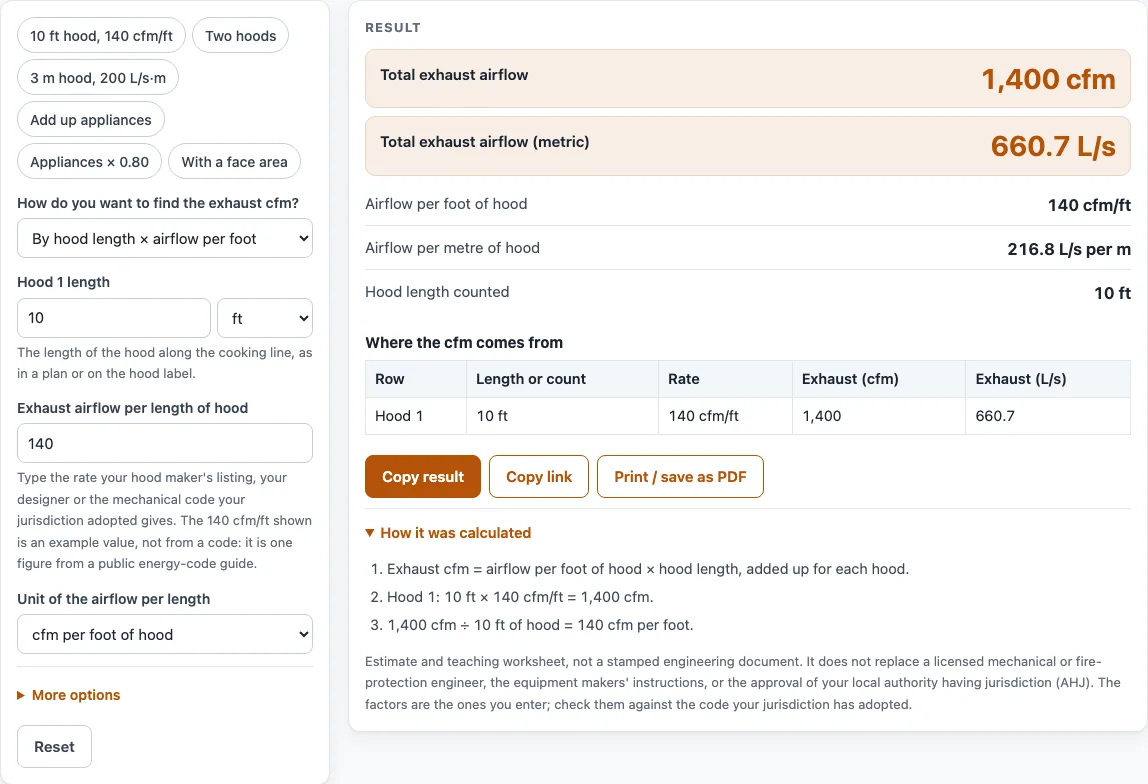
How to use the Commercial Hood CFM Calculator
- Choose a method: “By hood length × airflow per foot” or “By appliance (listed cfm for each)”.
- For the length method, type the Hood 1 length (required) in ft, in, m or mm.
- Type the “Exhaust airflow per length of hood”, in cfm per foot or L/s per metre. Use the rate from your hood listing, your designer, or your adopted mechanical code. The 140 cfm/ft starting value is an example, not from a code.
- For more hoods, open “More options” and enter hoods 2 to 4. A blank rate uses the hood 1 rate.
- For the appliance method, enter up to six lines: a name, an exhaust value in cfm, L/s or m3/h, and a count. The starting rows are examples only.
- Check the “Diversity multiplier”. It starts at 1.00, meaning all appliances run at the same time. Change it only if your designer or the hood listing says so; other values trigger a warning.
- If you want a face velocity, enter face width and height under “More options”. Fill both or leave both empty.
- Read the “Total exhaust airflow” in cfm and L/s. Check the table of rows, the “How it was calculated” section, and any warning about a rate below 20 or above 1,000 cfm/ft.
The presets fill the form with examples you can edit: “10 ft hood, 140 cfm/ft”, “Two hoods”, “3 m hood, 200 L/s·m”, “Add up appliances”, “Appliances × 0.80” and “With a face area”.
How is kitchen hood exhaust cfm calculated?
Exhaust cfm for a hood is the airflow per foot of hood multiplied by the hood length in feet. You work out each hood this way and then add the results together. The County sheet in the sources uses this same relation.
For example, 10 ft at 140 cfm/ft gives 1,400 cfm, which is 660.7 L/s. Two hoods, 10 ft at 140 and 6 ft at 210 cfm/ft, give 2,660 cfm over 16 ft, an average of 166.3 cfm per foot. A metric example is 3 m of hood at 200 L/s per metre, which gives 600 L/s, or 1,271 cfm.
The 140 cfm/ft figure is an example. It comes from the California Energy Commission 2019 guide, where it is a maximum for large kitchens. Other jurisdictions set minimums, which can be higher, so always confirm the rate for your project.
What does the diversity multiplier do in an appliance total?
In the appliance method, each line gives count x cfm, and the page adds these lines together. The diversity multiplier then scales that sum. A value of 1.00 assumes all appliances run at once.
The starting rows are two fryers at 400 cfm each, a griddle at 500 cfm and a range at 700 cfm. Together they sum to 2,000 cfm. With the 10 ft hood length, that is 200 cfm per foot. The “appliances x 0.80” preset applies a multiplier of 0.80 to the same kind of sum. Use a multiplier other than 1.00 only when your designer or the hood listing gives that value.
How is face velocity calculated from a hood opening?
If you enter face width and height, the page divides the total cfm by the face area. This is the continuity relation, V = Q / A, where Q is airflow and A is area. The result is shown in ft/min and m/s.
For a 10 ft by 2 ft face, the area is 20 ft². A total of 1,400 cfm gives 70 ft/min, or 0.3556 m/s. Both width and height must be filled, or both left empty. Face velocity is only as reliable as the airflow and area you enter.
Which numbers are examples and which come from a source?
Only a few figures come from a published source. The formula, exhaust cfm equals airflow per linear foot times hood length in feet, is the one printed on the San Bernardino County environmental health data sheet. The 140 cfm/ft value is one figure from the California Energy Commission guide. The page stores no rate table by duty class or hood type, so you type the rate yourself. A rate below 20 or above 1,000 cfm/ft only triggers a plausibility warning, not a code limit.
Worked examples
| Input | Result |
|---|---|
| 10 ft of hood at 140 cfm/ft | 1,400 cfm (660.7 L/s) |
| 16 ft of hood at 166.3 cfm/ft | 2,660 cfm (1,255 L/s) |
| 9.843 ft of hood at 129.2 cfm/ft | 1,271 cfm (600 L/s) |
| Appliance listing cfm added up, diversity 1 | 2,000 cfm (943.9 L/s) |
| 10 ft of hood at 140 cfm/ft | 1,400 cfm (660.7 L/s) |
Calculated by the tool above; open it with the same values to see each step.
Frequently asked questions
Does a result from this kitchen hood cfm calculator meet code?
The page does not say whether a result meets any code. Results are calculated from the values and factors you enter. The page is not a stamped engineering document, so confirm your design with a licensed engineer and the authority having jurisdiction (AHJ).
Where do I get the cfm per foot rate?
The page does not store an exhaust-rate table. Take the rate from your hood listing, your designer, or the mechanical code your jurisdiction adopted. The 140 cfm/ft starting value is an example, not from a code.
Why does my result show a warning?
A rate below 20 or above 1,000 cfm/ft triggers a warning. This is a plausibility check on the number and the unit you typed, not a code limit. A warning about the diversity multiplier appears when the value is above or below 1.00.
Can I use metric units?
Yes. Lengths can be typed in ft, in, m or mm. The airflow rate can be entered as L/s per metre of hood. One cfm/ft equals 1.5484 L/s per m.
How many hoods or appliances can I add?
You can add one to four hoods. Hood 1 is required, and hoods 2 to 4 are optional under “More options”. The appliance method has up to six lines.
Why might the rate in my area differ from the example?
The sources differ. The 140 cfm/ft figure is a maximum for large kitchens in the California Energy Commission 2019 guide. Other jurisdictions set minimums that can be higher. Use the rate that your hood listing or adopted code gives for your project.
Related tools
- Commercial Kitchen Hood Sizing Worksheet: use it when you are working through the sizing steps for a commercial kitchen.
- Exhaust Hood Calculator: use it when you want a general exhaust hood calculation.
- Type 1 Hood: read it to understand the Type 1 hood category.
- Type 1 vs Type 2 Hood: read it to compare the two hood types side by side.
- Type 2 Hood: read it to understand the Type 2 hood category.
- Ventless Hood Guide: read it if you are considering a ventless hood.
- Commercial Kitchen Exhaust Fan Calculator: use it when you want to look at the exhaust fan side of the same worksheet.
- Make-Up Air Unit for Kitchen Hood: use it to see make-up air against the exhaust total.
- Commercial Kitchen Hoods: the hub page for all hood tools and guides.