Air Changes per Hour Calculator
Enter the room size and the airflow to see the air changes per hour, or type a target ACH to see the airflow needed, plus the time to clear the air.
Recent
Your last 10 settings, saved only in this browser. Nothing is uploaded.
This air changes per hour calculator tells you how many times the air in a room is replaced in one hour, using ACH = 60 × Q ÷ V, where Q is the airflow in cfm and V is the room volume in ft³. It also gives air changes per minute, minutes per air change and the time to remove a chosen share of an airborne contaminant in a well-mixed room. It runs in your browser, is free, needs no sign-up and uploads nothing.
Use it to compare a room’s airflow with a target from your own standard, designer or equipment data. Results are calculated from the values and factors you enter. They are an estimate and a teaching worksheet, not a stamped engineering document, and they do not replace a licensed engineer, the hood maker’s instructions or the authority having jurisdiction (AHJ).
How to use the Air Changes per Hour Calculator
- Under “Solve for”, choose “Air changes per hour from airflow” or “Airflow needed for a target ACH”.
- Enter the room size as length × width × height in ft, in, m or cm. You can also enter the volume directly in ft³ or m³.
- In the first mode, type the “Airflow (Q)” and pick its unit: cfm, L/s or m³/h.
- In the second mode, type the “Target air changes per hour (ACH)”. The airflow answer is shown in the unit you chose on the airflow field.
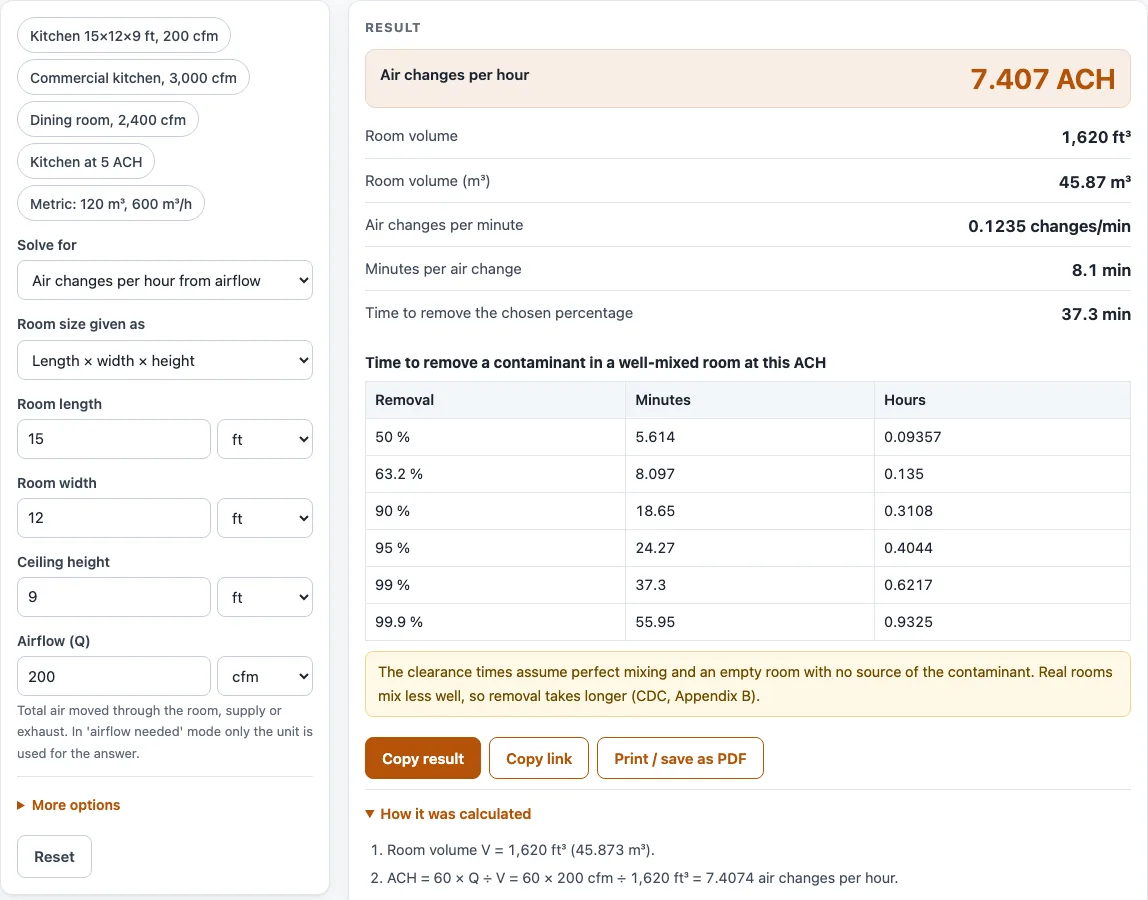
- Read the ACH result. Also check the room volume in both ft³ and m³, the air changes per minute, and the minutes per air change.
- Read the “Time to remove the chosen percentage”. The default is 99 %. To change it, open “More options” and edit “Contaminant removal for the clearance time (%)” to a value below 100.
- Read the table of removal times for 50, 63.2, 90, 95, 99 and 99.9 % at your ACH.
- Check for warnings. The tool flags entries above 100 ACH and below 0.1 ACH as unusual, so recheck your units and room volume if you see one.
Five presets fill in example values so you can see how the fields work: kitchen 15×12×9 ft at 200 cfm, commercial kitchen at 3,000 cfm, dining room 40×30×10 ft at 2,400 cfm, kitchen at 5 ACH, and a metric case. Start with a preset, then replace the numbers with your own.
What does air changes per hour mean?
Air changes per hour (ACH) is the number of times the full volume of air in a room is replaced in one hour. A value of 6 ACH means the room’s air volume passes through the space six times each hour. Because ACH scales airflow by room volume, it lets you compare ventilation between rooms of different sizes.
What is the air changes per hour formula?
The formula is ACH = 60 × Q ÷ V, where Q is airflow in cfm and V is room volume in ft³. The 60 converts airflow per minute into airflow per hour, since cfm measures cubic feet per minute. Equivalent forms are airflow in m³/h divided by volume in m³, or airflow in ft³/h divided by volume in ft³. For example, 200 cfm moving through a 1,620 ft³ kitchen gives 60 × 200 ÷ 1,620 = 7.407 ACH.
How do you calculate air changes per hour?
Start with the room volume. Multiply length by width by height, using the same unit for all three. A 15 × 12 × 9 ft room has a volume of 1,620 ft³, which is 45.87 m³. Then divide the airflow by the volume and convert to an hourly rate. Using the formula above, 200 cfm gives 7.407 ACH. Each air change takes 60 ÷ 7.407 = 8.1 minutes.
The calculation also works in metric units. A 120 m³ room with 600 m³/h of airflow is 600 ÷ 120 = 5 ACH, with one air change every 12 minutes.
To go the other way, use Q = ACH × V ÷ 60 cfm. In the 1,620 ft³ kitchen, a target of 6 ACH needs 6 × 1,620 ÷ 60 = 162 cfm.
How long does it take to remove a contaminant at a given ACH?
The time to remove a chosen percentage x of an airborne contaminant in a well-mixed room is t = −ln(1 − x) ÷ ACH hours, shown here in minutes. This is the formula in CDC Appendix B. At 6 ACH, removing 99 % takes 46.05 minutes and removing 99.9 % takes 69.08 minutes. The CDC table shows 46 and 69 minutes because it rounds to whole minutes. The 63.2 % point (1 − 1/e) is one time constant, which equals 60 ÷ ACH minutes, or 10 minutes at 6 ACH.
Why might removal take longer in a real room?
The times assume perfect mixing and an empty room with no contaminant source. CDC notes that real rooms mix less well than this model, so removal takes longer. Treat the table as a best-case estimate for planning, not a prediction for a specific space.
Does this calculator tell me the right ACH for my kitchen?
No. The page does not state a required ACH for any room type, so you need to enter a target from your own standard, designer or equipment data. An example is a 30 × 20 × 10 ft commercial kitchen (6,000 ft³) with 3,000 cfm, which gives 30 ACH and one air change every 2 minutes. That is an example calculation, not a value taken from a code. The results are calculated from the values and factors you enter. They are not a stamped engineering document and do not replace a licensed engineer, the hood maker’s instructions or the authority having jurisdiction (AHJ).
Worked examples
| Input | Result |
|---|---|
| room 15 × 12 × 9 ft, 200 cfm | 7.407 ACH; 99 % removal in 37.3 min |
| room 30 × 20 × 10 ft, 3000 cfm | 30 ACH; 99 % removal in 9.21 min |
| room 15 × 12 × 9 ft, 6 ACH target | 162 cfm |
| room 120 m³, 600 m³/h | 5 ACH; 99 % removal in 55.3 min |
| room 6 × 5 × 3 m, 15 ACH target | 375 L/s |
Calculated by the tool above; open it with the same values to see each step.
Frequently asked questions
Is the air changes per hour calculator free to use?
Yes. It runs in your browser, is free, and needs no sign-up. Nothing you type is uploaded.
What is the ACH formula for metric units?
ACH = airflow in m³/h ÷ room volume in m³. For example, 600 m³/h in a 120 m³ room is 5 ACH, with one air change every 12 minutes.
Can I enter airflow in L/s?
Yes. Choose L/s on the airflow field when you enter the airflow. The answer is then given in the unit you chose.
What does the 99 % removal time mean?
It is the time for 99 % of an airborne contaminant to be removed in a well-mixed room with no source. At 7.407 ACH, the default kitchen takes about 37.3 minutes.
Can I change the removal percentage?
Yes. Open “More options” and enter a percentage. The default is 99 %, and the value must be below 100.
Why do I see a warning?
The tool shows a warning above 100 ACH and below 0.1 ACH to mark an unusual entry. Check your units and room volume first. A standing warning also reminds you that the removal times assume perfect mixing and an empty room.
Does this tool judge whether my design is acceptable?
No. The tool does not check any code or inspection requirement and gives no verdict. Results are calculated from the values and factors you enter, and they do not replace a licensed engineer, the hood maker’s instructions or the authority having jurisdiction (AHJ).
Related tools
- Kitchen Exhaust Fan Size Calculator: Use it when you are sizing an exhaust fan for a kitchen space.
- Make Up Air for a Range Hood: Use it to read about supplying replacement air when a range hood exhausts air.
- Heated Make Up Air Unit Calculator: Use it to estimate the heating side of a make up air unit.
- Make Up Air Unit for Kitchen Hood: Use it to learn how make up air units are used with kitchen hoods.
- Range Hood CFM Calculator: Use it to estimate the airflow a range hood needs.
- Make-Up Air, Air Changes and Kitchen Exhaust: Browse the whole group of replacement air and exhaust worksheets.
- Kitchen Hood CFM Calculator: Use it to estimate exhaust cfm by hood length.
- Duct Velocity Calculator: Use it to relate airflow to duct size and velocity.